
News
South Korean president’s anti-communist taunts are opening up deep divisions as country ponders alliance with Japan and US

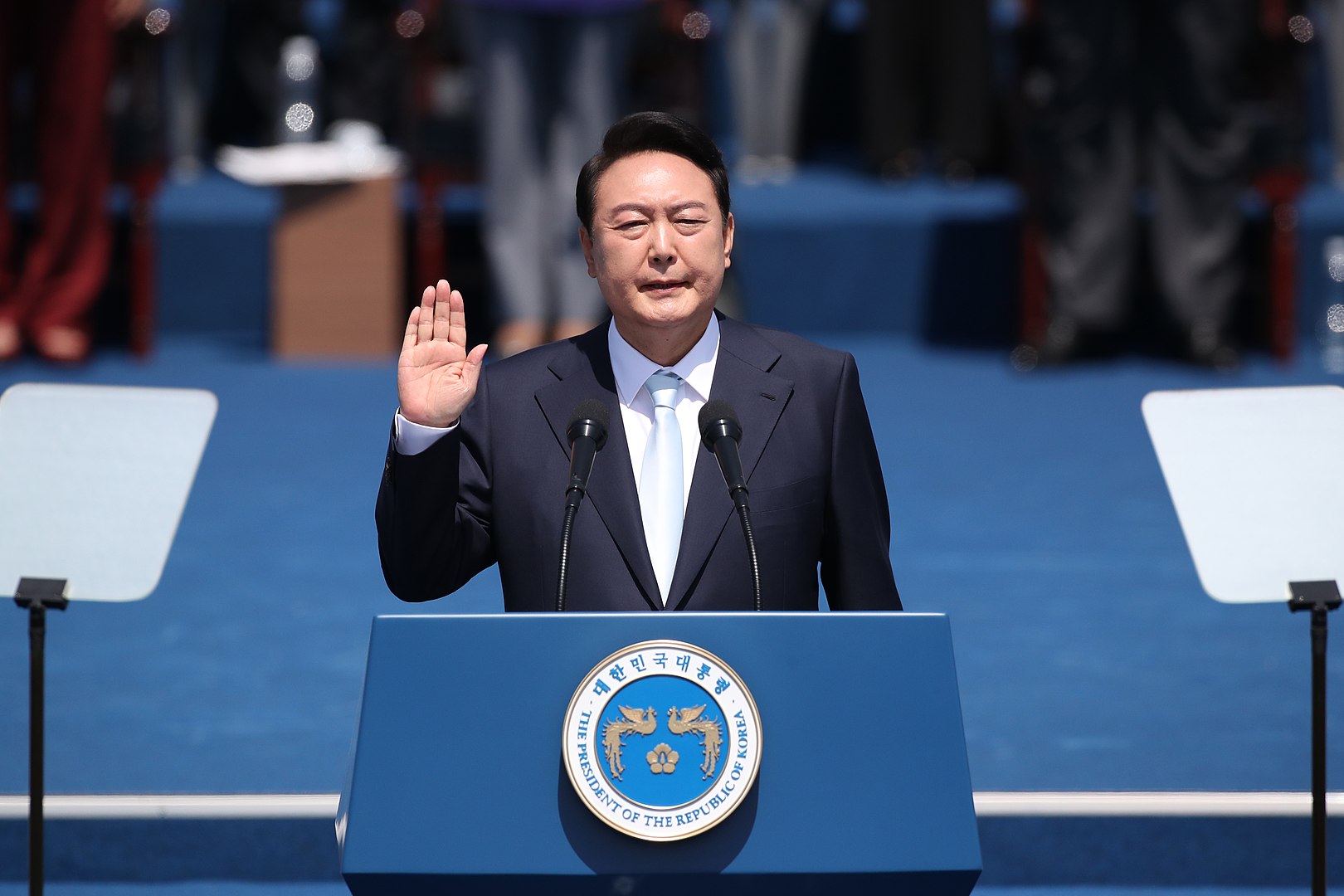
FILE: Yoon takes the presidential oath of office outside the National Assembly, 10 May 2022. (Photo By Republic of Korea from Seoul, Republic of Korea/Wikimedia Commons, CC BY-SA 2.0)
Recent heated debate in South Korea about how its colonial-era independence movement should be remembered has exposed the deep faultlines that run through the country’s politics, between the conservative and liberal-progressive camps.
At the end of August, the Korean Military Academy announced its intention to relocate the statue of independence activist General Hong Beom-do from its front lawn, along with that of four other independence activists. In addition, South Korea’s defence minister, Lee Jong-sup, openly considered renaming a navy submarine that had also been named after General Hong.
Hong Beom-do is remembered for leading the Korean Liberation Army to victory over Imperial Japan in the 1920 battle of Fengwudong. But the academy and the conservative Yoon Suk Yeol administration take issue with the fact that Hong later sought refuge in the Soviet Union and became a member of the Communist Party.
This furore over Hong’s statue more broadly has come against a background of an intensification of red-baiting rhetoric by the Yoon administration. In his August 15 Liberation Day speech, Yoon argued that: “The forces of communist totalitarianism have always disguised themselves as democracy activists, human rights advocates or progressive activists while engaging in despicable and unethical tactics and false propaganda. We must never succumb to the forces of communist totalitarianism.”
The implication of such statements has been that any opposition to the Yoon government’s policies are a result of the forces of “communist totalitarianism”.
Yoon’s actions are a recurrent feature of South Korea’s increasingly polarised political culture. Incumbent administrations go to great lengths to differentiate themselves from their predecessors.
It is no coincidence that the bust of Hong and the other independence fighters had originally been placed there in 2018 by the preceding liberal-progressive Moon Jae-in government.
Foreign policy realignment, domestic dissent
A more immediate factor is recent realignments in South Korea’s foreign policy. Seoul is moving toward closer cooperation with the United States and Japan. For decades, tensions between Japan and South Korea have impeded Washington’s goal of bringing the two countries together in a trilateral alliance to tackle challenges from China and North Korea.
Anti-Japanese sentiment remains strong in South Korea. This is sustained by Japan’s perceived failure to address historical wrongdoings during the colonial and wartime eras. As a result, many Koreans remain wary of closer security cooperation. The Yoon government, however, has unilaterally abandoned longstanding Korean demands for Japan to show greater remorse, and for victims’ compensation.
Yet this pursuit of trilateral security cooperation at all costs has created a legitimacy crisis for the government, which is seen by many to be increasingly out of step with much of the public. Rather than seeking to convince the public through persuasive argument, the Yoon government has increasingly resorted to red baiting.
On September 1, Yoon gave a speech at the Korean National Diplomatic Academy in which he implied that any criticism of his administration’s pro-US and pro-Japan leanings were again a result of “communist totalitarian” or “anti-state” forces.
Korean conservatism – an Achilles heel
In several respects Yoon’s approach reflects longer-term fissures within Korean politics since it transitioned to democracy in 1987. Since then, South Korean conservatives (and in particular the so-called ch’inilp’a, or “pro-Japanese faction” whose wealth and power date back to collaboration with the Japanese) have suffered from a chronic deficit of legitimacy.
During the post-liberation era, they compensated for this with an ideology of virulent anti-communism. As a result, the main split in Korean society came to be defined as between communist and anti-communist – rather than between nationalist and collaborator. Anything that was judged to go against the authoritarian conservatism of the era was defined as “benefiting the North”.
The firm grip held by the authoritarian regime in post-liberation South Korea meant that there was little need to develop any genuinely conservative ideology. But the democratic transition made it increasingly difficult for conservatives to adhere to the logic of communism versus anti-communism.
Liberal governments, backed by the rising power of new civic movements, were able to attack conservatives for their history of colonial collaboration and post-war authoritarianism. Conservatives were blamed for episodes seen as having caused national humiliation. These include the 1965 Japan-Korea Treaty and the Kwangju massacre of 1980 in which a pro-democracy movement in the southwest of the country was brutally suppressed by the Korean military.
One broad response to this challenge has been the emergence since the 2000s of an alternative so-called “New Right” history movement. This explicitly sought to establish a new moral grounding for South Korean conservativism. It aimed to address a perceived ideological vacuum through a strong belief in free market liberalism. This was combined with the promotion of a more positive view of the Japanese colonial occupation and the involvement of the US in Korea’s modern development.
The New Right movement largely failed to make an impact in the academic study of history in Korea. But Yoon has appointed prominent New Right figures to key government positions. Their views have evidently had an impact on his thinking and rhetoric.
But his increasing reliance on red-baiting seems at odds with the aspirations of New Right ideologues to put conservatism on a firmer and more persuasive ideological basis. Instead it feels like a throwback to the cold war McCarthyism.
Yoon’s simple anti-communist rhetoric is unlikely to appeal to the majority of the South Korea public – many of whom find themselves associated with the president’s notion of “communist totalitarianism”.
But while Yoon’s red-baiting may be politically ineffectual, it looks set to deepen the polarisation of politics in South Korea. This could threaten the principles of democracy in Korea by de-legitimising dissent.
Kevin Gray, Professor in International Relations, University of Sussex
This article is republished from The Conversation under a Creative Commons license. Read the original article.




















