
Art and Culture
How science museums reinvented themselves to survive the pandemic

During lockdown, institutions untethered their programs from their buildings with some creative results
On January 30, 2020, Science Gallery Dublin assembled a small group of experts to discuss a strange new disease that had recently emerged in China. Four panelists talked about the origins of the new coronavirus, whether it might be airborne and the prospects for a vaccine. While they agreed that it was important to take the virus seriously, the speakers urged the audience not to panic. There had been no known cases in Ireland. The prospect of a local outbreak seemed remote.
“And that was the last live event we held in the gallery,” says Aisling Murray, the gallery’s head of programming. That very day, the World Health Organization declared the COVID-19 outbreak a “public health emergency of international concern.” Six weeks later, with cases on the rise all over the globe, Science Gallery Dublin shut its doors. It was a moment of reckoning. “What does Science Gallery mean when we don’t have a space?” Murray recalls wondering. “How do we continue to engage our audience?”
As the COVID-19 pandemic began to spiral out of control in March 2020, science museums around the world were forced to abruptly close. In a matter of days, ticket revenue vanished. “It was an existential crisis,” says Christofer Nelson, president and CEO of the Association of Science and Technology Centers, or ASTC, in Washington, D.C. “The fundamental business, operational, staffing, community service model of these organizations just went away overnight. And the question was ‘What do we do next?’ ”
The weeks and months that followed were excruciatingly difficult for science museums, which lost more than $600 million in revenue in just the first six months of the pandemic, the ASTC estimates. Many museums and science centers were forced to adopt deep cost-cutting measures; some laid off more than half of their employees.
Few science museums had substantial endowments to pull from, so they scrambled for support. They launched new campaigns for donations, applied for government loans and sought grants and support from community organizations or corporations.
As they tried to make ends meet, they also realized they had to reinvent their programs if they wanted to survive. Over the last year, they have launched a diverse array of exhibits and offerings that are not tied to their physical buildings, and they have helped educate the public about COVID-19. Some museums have even found creative ways to meet serious community needs, providing everything from child care to fresh food.
Along the way, these institutions have redefined what modern science museums can be and how they engage with the world beyond their walls. Though many museums are in various phases of reopening, their experience over the last year may leave a lasting legacy.
Hasty pivot
When museums initially closed last year, most administrators thought the disruption would last only a few months. In those early days and weeks, the institutions shifted into crisis response mode, scrambling to create some kind of public programming. “Within a couple of weeks, we were spinning up what now we would call ‘minimum viable products,’ ” says Tim Ritchie, president of the Museum of Science in Boston. Staff members who typically spent their days giving face-to-face presentations inside the museum on topics from reptiles to space started delivering those talks over Zoom. “It was not that great at first,” Ritchie admits. “But people were hungry [for it], and they tuned in.”
Many institutions did the same, making some of their traditional exhibits and programs virtual. By the end of March 2020, the California Academy of Sciences in San Francisco had turned its program called NightLife — a regular Thursday night event that charged from $10 to $20 for admission to the museum for science, music and cocktails — into a free weekly online program called NightSchool.
The Great Lakes Science Center in Cleveland converted its in-person demos into Curiosity Corner LIVE! This daily YouTube broadcast included science demonstrations and activities — such as building catapults and lava lamps — for kids and families to do at home.
Seattle’s Pacific Science Center filmed the live science shows that it typically staged in person and shot a series of behind-the-scenes videos, featuring Senora the tarantula, Rigatoni the western hognose snake and other animals in its collection. “We recorded everything that we could, as quickly as we could,” says Zeta Strickland, the center’s director of preK–12 engagement. The center’s most popular live science show, Combustion, has had more than 6,500 views on YouTube.
Museums also used their science communication expertise to address the pandemic itself. There was an “immediate and urgent recognition that this crisis was fundamentally a crisis of science engagement,” says the ASTC’s Nelson.
Shannon Bennett, a virologist who happens to be the California Academy of Science’s chief of science, fielded online questions about COVID-19, while the Pacific Science Center designed an online landing page for pandemic-related information. The page includes a pandemic glossary, a vaccine explainer and a guide to identifying misinformation. The website also offers a curated collection of news articles and links to trusted sources, such as the U.S. Centers for Disease Control and Prevention. “There was so much misinformation and disinformation out there, so we really wanted to be a resource where people can find accurate information,” says Danielle Cobb, marketing communications manager for the Pacific Science Center.
Some museums stepped up to meet more basic community needs. The Mid-Hudson Children’s Museum in Poughkeepsie, N.Y., had started running a weekly summer farmers market in its pavilion in 2017. When the pandemic hit, local schools, which offer free breakfast and lunch to all students, shut down. “There was a huge focus on how do you get food to kids that they would otherwise get through the school,” says Lara Litchfield-Kimber, the museum’s executive director. “What we realized is that in our city, we had an essential business.”
The museum rallied its vendors and opened the market, which accepts food stamps, in May, a month before its typical start. The market became a hub of activity, and museum staff worked with city officials to distribute flyers, in English and in Spanish, about COVID-19. (The museum is exploring the possibility of hosting a year-round market.) “The museums that are … maintaining their strength are those that recognize how to leverage their assets to address the urgent needs of their community,” Litchfield-Kimber says.
On the other side of the country, the Oregon Museum of Science and Industry in Portland started offering child care for 20 to 30 children of essential workers. “We have the training. We have the certifications. We have the people. We have the stuff to have kids in the museum — that’s just what we do,” says John Farmer, the museum’s former marketing and communications manager.
In the fall, the museum converted the child care program into Homeroom, offering a place where children who were enrolled in remote school could spend their days. The museum prioritized families in need, Farmer says, and offered financial aid for the program, which has enrolled more than 100 students over the last year. San Diego’s Fleet Science Center organized similar distance learning hubs so children could go to the center and connect to their remote classrooms.
Many museums also put together resources for schools that had shifted to remote teaching. The California Academy of Sciences reformatted its planetarium films for YouTube so teachers could show films like Expedition Reef and Fragile Planet to their students. The center also offers free distance learning livestreams, in English and in Spanish, for students from kindergarten through eighth grade.
The New York Hall of Science in Queens began offering virtual science workshops to schools: A museum educator leads an entire class of kids through an hour of activities and demonstrations on topics ranging from optical illusions to the science of sports. The workshops, which cost $150 for a group, sell out months in advance. “What teachers want is a bit of relief,” says Margaret Honey, president and CEO of the New York Hall of Science. “They really gravitate toward the experiences.”
Pushing the envelope
As the pandemic dragged on, museums started to think longer term. They got more ambitious and creative. “We decided to get better at being digital,” Ritchie says.
Last summer, Boston’s Museum of Science created Ask a Virtual Expert, an experience powered by artificial intelligence featuring Ashish Jha, dean of the School of Public Health at Brown University in Providence, R.I. Museum staff filmed Jha as he answered more than 500 questions on COVID-19 and then turned the footage into an interactive exhibit. Members of the public can pose questions about the pandemic directly to a digital version of Jha, and he responds.
The Smithsonian, which began 3-D scanning some of its artifacts years ago, used the time that its doors were closed to improve its digital 3-D offerings. On its website, for instance, visitors can peruse or download free, 3-D scans of everything from the Apollo 11 command module to a complete woolly mammoth skeleton. In December, the institution announced a partnership with Instagram that allows users of the photo sharing app to display virtual versions of famous Smithsonian artifacts in their own personal spaces. “You can drop the space shuttle Discovery in your backyard and have your family standing next to it and have a screenshot and share it on Twitter,” says Vincent Rossi, supervisor of the 3-D program for the Smithsonian’s Digitization Program Office.
Other museums found clever ways to create in-person experiences that were COVID-19 safe. Science Gallery Dublin, located on the campus of Trinity College Dublin, took advantage of the glass facade on one side of its building, installing five pandemic-related exhibits just inside the glass. Passersby could peer into the windows and see a cluster of Lego figures arranged to demonstrate the concept of herd immunity or a sensor-laden, 3-D printed dress with a skirt that spreads out to enforce social distancing.
Called “Speed of Science,” the exhibition was produced in partnership with the pharmaceutical company Pfizer, which had collaborated with the gallery on a pop-up exhibit in 2019. The exhibit’s online hub, which includes a podcast on vaccination and vaccine development, has had nearly 5,000 visits.
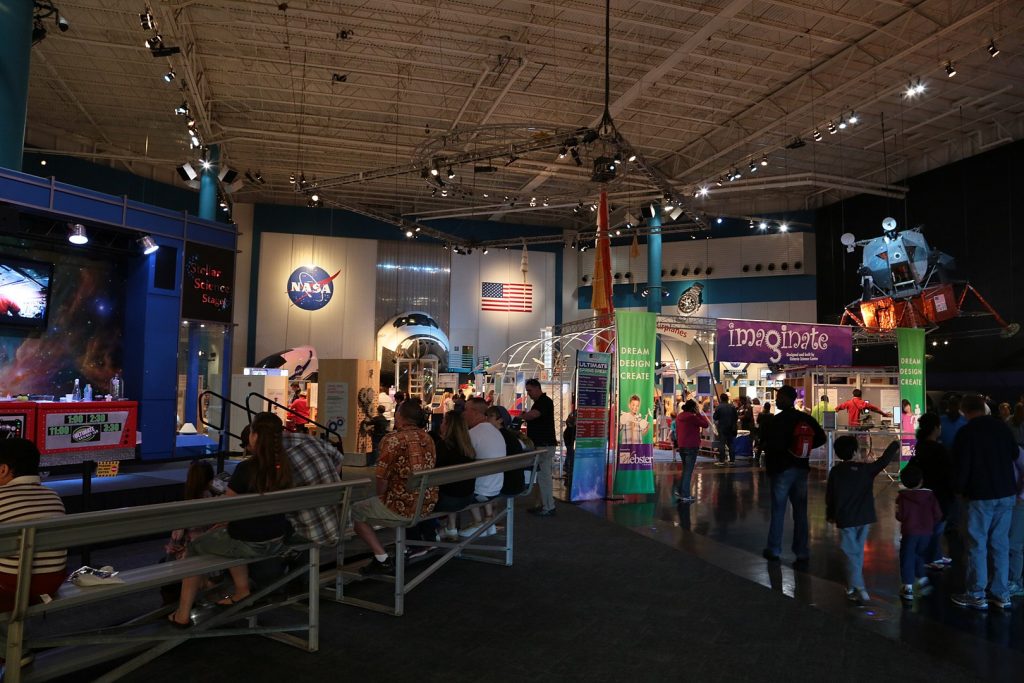
Last summer, Space Center Houston offered “clean room” camps, which simulated the experience of working in one of the NASA facilities dedicated to ensuring that the objects the agency launches into space are free of potential contaminants. Upon arrival at camp, kids donned gowns, gloves, masks, caps and shoe coverings. “Basically, we shrink-wrap the kids,” says William Harris, the center’s president and CEO. “It’s just like they’re in a clean room at NASA.” The camps were so popular that the center offered them again over the Thanksgiving, winter and spring breaks.
Meanwhile, the Mid-Hudson Children’s Museum used its closure in 2020 to begin a long-planned transition to becoming a more hands-on science center. To jump-start its science programming while the building was closed, the museum bought a van and partnered with NASA to turn it into a mobile, pop-up museum for outdoor, space-related demonstrations and activities.
Expanded reach
As difficult as the pandemic has been, it’s also given science museums an opportunity to make long-needed changes and pursue long-standing goals. Even before COVID-19 emerged, the Center of Science and Industry, or COSI, in Columbus, Ohio, had been wanting to find new ways to get out into the community. “Yes, we want to sell tickets to our building,” says Frederic Bertley, COSI’s president and CEO. “But we have to be more than that.”
When COSI closed in March 2020, its staff rolled out an assortment of digital offerings — and launched a TV show — but the team also wanted to re-create the hands-on, tactile experiences that have long been the cornerstone of science museums. The solution was an assortment of COSI Connects kits.
Each kit has five hands-on activities for kids that revolve around a theme: nature, water, space, dinosaurs or the human body. The kits can be purchased online, and COSI distributes them for free through food banks, Boys & Girls Clubs, homeless shelters and other organizations. The museum is in discussions to distribute them through school districts in Ohio and several other states.
“We weren’t trying to make money off of this,” Bertley says. “We were trying to make sure that COSI was still relevant, that a state-of-the-art science museum still had a fundamental role in society, even though we were closed.” COSI plans to continue offering the kits when the building reopens in early June. “This is how we can have a beyond-Ohio impact,” Bertley says.
Indeed, museums are discovering that untethering their programs from their physical buildings has expanded their reach. At the California Academy of Sciences, a pre-pandemic, in-person NightLife event typically attracted roughly 1,700 people. NightSchool, the virtual version, averages more than 10,000 views per installment. These events are free; they don’t bring in money. But, says senior digital engagement and community manager Laurel Allen, “we’ve been able to build bigger communities.”
Although the academy initially thought of its online events as a stopgap measure, it has decided to continue them in some form now that the museum has reopened. The majority of viewers are outside the Bay Area and are unlikely to make regular in-person visits.
An immersive virtual tour created by the National Museum of Computing in Milton Keynes, England, last summer has attracted more than 140,000 visitors from the United Kingdom, United States, India and Brazil. “I don’t think we ever took for granted the audience reach that we had,” says Jacqui Garrad, the museum’s director. “But I do think that we maybe didn’t try hard enough to engage some of the outside communities.”
Some museums have invested in accessibility, overhauling websites to be more friendly to visitors who are blind or have low vision and offering digital programs specifically for visitors who are deaf and hard of hearing. Others have increased their free offerings and resources for low-income families and other underserved communities. The Museum of Science in Boston launched MOS en Español, an online hub for programming in Spanish.
Of course, the pandemic — and the threat to museums’ basic business model — is not over yet. “I don’t think we’re by any means out of the woods,” ASTC’s Nelson says. Museums were “great at cutting costs,” he adds. “But they’re now at the bare minimum.”
In a June 2020 survey of 750 museum directors, one-third reported that their institutions were at “significant risk” of closing permanently. So far, the ASTC is aware of just one permanent closure among science museums: the Orpheum Children’s Science Museum in Champaign, Ill. And while some museums have reopened, visitors have been slow to return; attendance is about half pre-pandemic levels, according to ASTC’s ongoing attendance survey.
Soon after the pandemic hit, ASTC lobbied the federal government to include museums in relief efforts and pulled together online resources to help its members navigate new financial and operational realities. In the first round of the federal Paycheck Protection Program, nearly 300 of ASTC’s members received loans totaling more than $180 million.
When museums close, it’s a huge loss for their communities, Nelson says. “Museums really serve as a critical part of their communities’ economic, cultural and learning ecosystems.”
But the museums that survive may emerge more nimble and resilient — and able to serve the public in new and urgent ways. “We need to double down on this idea of wanting to respond at all times to what the community needs,” says Steven Snyder, president and CEO of San Diego’s Fleet Science Center. “It’s also a proof of concept that we’re not locked to our building. Science centers never have been.”
This story was originally published by Science News, a nonprofit independent news organization.




















