
Headline
Nobel Peace winner Kailash Satyarthi abandoned engineering to defend children’s rights

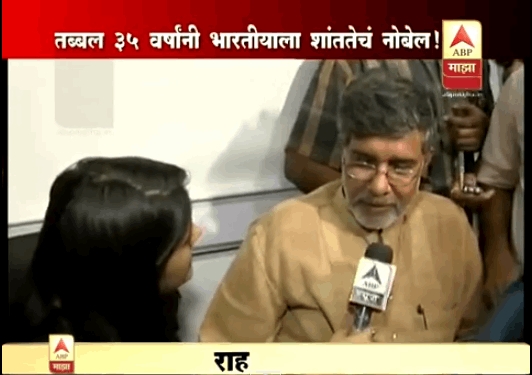
Kailash Satyarthi. Screenshot from ABP MAJHA / Youtube.
NEW DELHI—On his first day in school Kailash Satyarthi saw a young boy polishing shoes outside the school gates. The memory of that incident stayed with him, he said, leading him to give up a career in engineering to spend his life fighting India’s endemic child labour.
“It was a very sharp contrast,” he says of watching that boy, unable to go to school, clean the shoes of other little children who had the “hopes and aspirations” that education brings.
On Friday, Satyarthi, 60, was awarded the Nobel Peace Prize along with Pakistan’s Malala Yousafzai for having devoted three decades of his life to defending children’s rights.
“I strongly feel that this is a big honour to hundreds of millions of the children who have been deprived of their childhood and freedom and education. So it’s a big challenge and this will help in our fight against child labour and child slavery globally, and particularly in my own country,” he said.
Satyarthi was born in Vidisha in the central Indian state of Madhya Pradesh in 1954 and studied to be an electrical engineer. He abandoned that career path in the early 1980s to start helping children who were forced to quit school and start working, often at dangerous jobs, to support their families.
He founded Bachpan Bachao Andolan, or Save the Children Movement, because he believed that child labour “isn’t just about poverty. It’s more than that.”
He says the state and society have failed children, making them give up their childhood and education.
He helped free thousands of children from slave-labour conditions and advocated reforms as the leader of Bachpan Bachao Andolan and director of the South Asia Coalition on Child Servitude.
Satyarthi and others from his organization conducted raids on poorly lit and cramped workshops where dozens of children were illegally forced to weave carpets or saris. He would ask reporters and photographers to accompany his volunteers on the raids.
Dozens of scared and confused children would pour out of factories and sweatshops that his group raided.
He says the job was not without risks, and he often faced threats from factory owners. At least two people who worked with him were killed, he says.
In 1994, he founded a group now known as Goodweave which certifies child-labour-free rugs and provides assistance to rescued and at-risk children.
“Kailash Satyarthi has dedicated his life to helping the millions of children in India who are forced into slavery and work in torrid conditions. His award is an acknowledgement of the tireless, decades-long campaigning by civil society activists on child trafficking and child labour in India,” Amnesty International’s secretary general, Salil Shetty, said in a statement.
In 1998, Satyarthi was chairman of a global march against child labour that wound through more than 60 countries around the world. Children rescued from jobs in Asia, Africa and Latin America were among more than 1,000 people who ended the march in Geneva at the International Labor Organization. A year later, the ILO approved an accord designed to protect children from jobs that expose them to danger or exploitation.
Satyarthi has lobbied hard for extensive changes to India’s laws to protect children better.
Child labour remains widespread in India. An estimated 13 million children work, many in hazardous industries.
In 2006 India also banned the hiring of children under 14 as servants in homes or as workers in restaurants, tea shops, hotels or spas. But such laws continue to be routinely flouted.
It’s not unusual to find a poor 12- or 13-year-old child taking take of an infant for a middle-class family.
Small factories and businesses throughout the country also break the law. Children who work in such jobs are usually poorly paid, underfed and often beaten.
“Child slavery is a crime against humanity. Humanity itself is at stake here. A lot of work still remains but I will see the end of child labour in my lifetime,” Satyarthi says.
“I’m very optimistic.”