
News
Why paying people to get the coronavirus vaccine won’t work

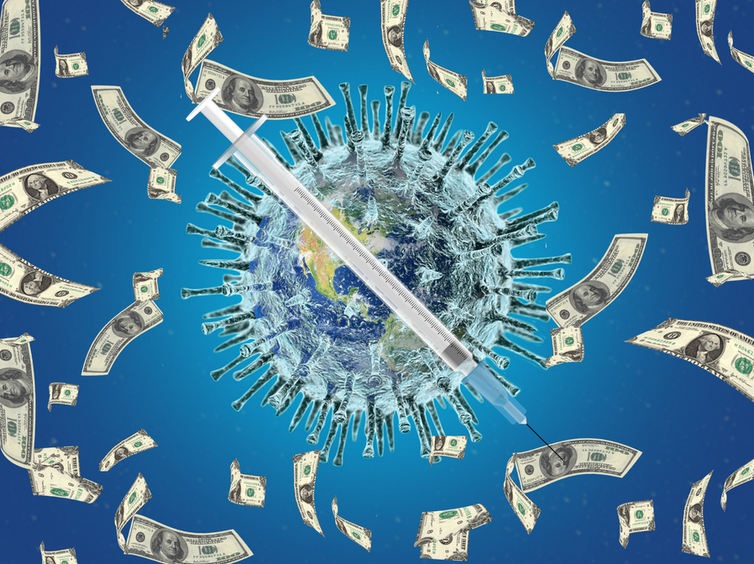
And people or organizations interested in promoting disinformation about vaccines may portray payment originating from the government as “proof” of deep-state or hidden agendas associated with vaccination. (Pixabay photo)
The first COVID-19 vaccine to gain emergency use authorization in the U.S. could roll out within days, as Pfizer and BioNTech’s candidate was endorsed by an external advisory panel to the Food and Drug Administration on Dec. 10. Two days earlier, an internal FDA panel endorsed the vaccine. These were the last required steps before the FDA authorizes the vaccine, which will soon be administered to health care workers across the country.
But while health care workers, who will be first to receive the vaccine, appear eager to get the shot, others are not so convinced. In fact, recent studies indicate that many Americans do not plan to get a COVID-19 vaccine, even if one is available at no cost.
If levels of vaccination are not robust, it will take longer to reach herd immunity, or widespread protection within a population. In response to these concerns, several people have suggested that the government should provide a monetary incentive to COVID-19 vaccination.
We are health law professors and, in our view, it is important to understand how these monetary incentives work as COVID-19 vaccines become available, why payment for vaccination may exacerbate vaccine mistrust, and how this incentive fits into the broader history of monetary incentives in public health.
The idea behind monetary awards for COVID-19 vaccination
In summer and early fall of 2020, several surveys indicated that the number of Americans planning to get vaccinated against COVID-19 was lower than desirable. Experts estimate that achieving herd immunity require anywhere from 67% to 85% of Americans to be vaccinated. A recent survey by the Pew Research Center showed that only 60% of American were considering getting a COVID-19 vaccine.
If vaccination rates are indeed low once vaccines become available on a large scale, it will take the U.S. longer to curb the pandemic. Moreover, many Americans expressing COVID-19 vaccine mistrust are part of are members of racial minorities, which are precisely among the groups hit the hardest by the pandemic.
The idea of monetary incentives seems straightforward: Pay people to get vaccinated. One of the earliest proponents, economist Robert Litan, called the idea an “adult version of the doctor handing out candy to children.”
Litan suggested that the government should pay US$1,000 to each person who receives a COVID-19 vaccine. He admitted in his proposal that he had not relied on any studies or data to get to this number, explaining that the proposed payment amount was a “hunch.”
His idea has since been endorsed by prominent commentators. These include economist Gregory Mankiw and politician John Delaney, who suggested that the incentive should be increased to $1,500.
When money works and when it doesn’t
Paying incentives to people who take on health risks to help others is not new. The most common example is clinical trials. Participants in these trials often receive set payments typically ranging from $25 to $1,000, to cover the costs of participation and perhaps to compensate for participants’ time.
Researchers don’t intend for these payments to induce subjects to take risks they would otherwise refuse. But there is a concern that, if clinical researchers pay potential subjects for risk-taking, their clinical trials will prey on poorer people for whom the payment would make the most difference. The law withholds authorization for clinical trials where there is reason to suspect that large payments were inducing people to take risks against their better judgment.
While a number of studies demonstrate that nominal payments rarely cause a person to consent to clinical research the person believes is risky, data show that payments as high as $1,000 cause potential participants to perceive the proposed research as highly risky. Those individuals seek out risk information and review it more closely than others who were offered significantly smaller payments.
Monetary compensation is also available in other cases. For instance, payments for the donation of plasma currently ranges from $30 to $60. Compensation for the donation of gametes is also possible, with $35-$125 being the range for sperm donations, and $5,000-$10,000 the range for egg donations.
There are also cases in which it’s been effective to nudge people to stop unhealthy behaviors. Studies have shown that paying people to stop smoking can be a powerful incentive. These studies offered smokers rewards that ranged from $45 to $700. People who received a reward were less likely to restart smoking, even after the monetary incentive ended.
Conversely, the Uniform Anatomical Gift Act expressly prohibits payment for organ donations. Here, the concern is that allowing payments would undermine the altruism underlying the current system such that nobody would give their organs for free if there is a market for them. And where there is a market, it will exploit the poorest among us, who are the most vulnerable.
In countries that do not prohibit payment for human organs, there is anecdotal evidence of unscrupulous brokers and health care providers who profit from the desperation of wealthy recipients at the expense of impoverished and vulnerable donors.
Why money for COVID-19 vaccination is different
In the medical context, monetary incentives are typically not available when participants take a health risk that nonetheless provides them with some likely personal benefit. Instead, payment is more likely for people who agree to participate in clinical trials where the participants are unlikely to benefit medically from their participation. This also applies to payments for donations of plasma and gametes given that donors do not benefit medically from their participation.
[Get our best science, health and technology stories. Sign up for The Conversation’s science newsletter.]
A massive payment plan designed to promote COVID-19 vaccination would be very different from current monetary incentives. In addition to its novelty, our concern is that such a scheme would have unintended consequences.
First, we have no actual behavioral studies in this area – as opposed to the case of smoking cessation rewards. Similarly, as the proponents of vaccination rewards admit, there is no data on how to set the appropriate reward.
Second, the proposal might backfire. People who already do not trust vaccines may consider the mere availability of payment as confirmation that vaccination is especially risky or undesirable. And people or organizations interested in promoting disinformation about vaccines may portray payment originating from the government as “proof” of deep-state or hidden agendas associated with vaccination. If people perceive the monetary incentive in this way, that could contribute to increased vaccine hesitancy – precisely the opposite of what it is intended to do.
Third, we worry about the socioeconomic underpinnings of this proposal. An amount close to $1,000 is supposed to prompt a person to change attitudes toward vaccination. In practice, this means that richer individuals, who might not be moved by $1,000, can just ignore the reward. Poorer people, however, are expected to change their behaviors in exchange for money. This is a paternalistic approach that does not help build trust in the government and public health authorities among poorer communities.
For these reasons, we urge caution to regulators and legislators in this area. We all want the pandemic to come to an end as soon as possible. But we need to get the incentives right, which entails relying on data, and not just on unstudied theories.
Ana Santos Rutschman, Assistant Professor of Law, Saint Louis University and Robert Gatter, Professor of Law, Saint Louis University
This article is republished from The Conversation under a Creative Commons license. Read the original article.