
News
Narendra Modi’s victory speech delivers visions of a Hindu nationalist ascetic

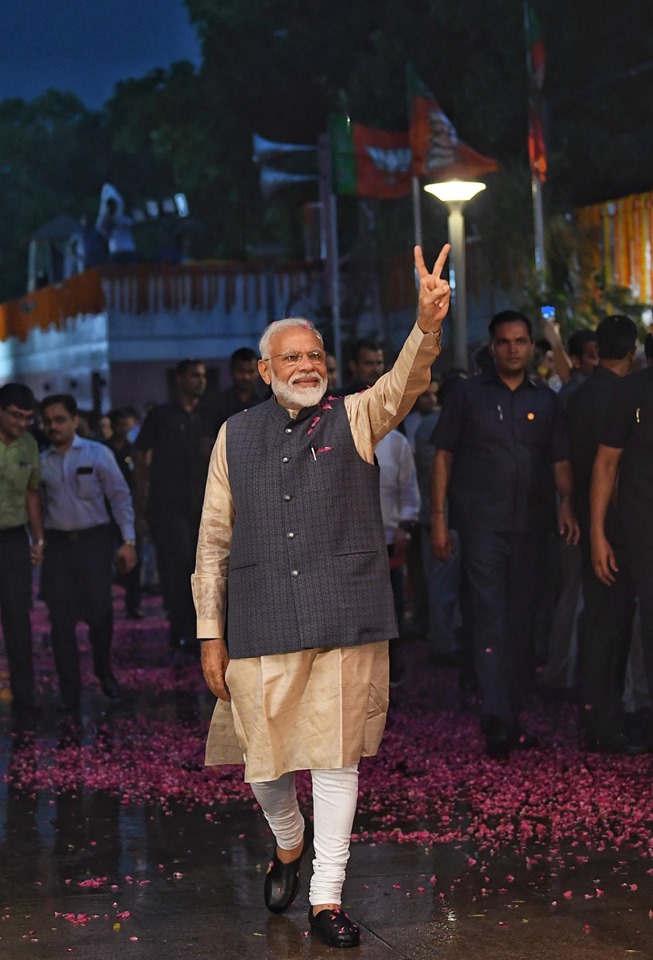
FILE: Humbled by people’s blessings. (Photo: Narendra Modi/Facebook)
In the recently concluded Indian parliamentary elections, the electorate gave a thumping majority to current Prime Minister Narendra Modi of the Hindu right-wing Bharatiya Janata Party (BJP) to lead the nation for another five years. In his victory speech at the BJP headquarters, Modi addressed the nation.
Throughout his speech, Modi crafted an image of himself as a Hindu ascetic who renounces worldly possessions, not for personal liberation but to serve the nation’s needy — a karmayogi. This image of the selfless Hindu ascetic devoted to the nation has been carefully cultivated over decades by the Hindu right.
The creation of this figure is partly a response to the British colonial denigration of Hindu ascetics as wilfully idle, otherworldly, apathetic and apolitical. It is also a response to the secular middle class derision of monks in saffron robes entering politics.
India has seen a remarkable public resurgence of Hindu ascetics in politics since the 1980s, with the ascendance of the Hindu right. Notable political figures include the Chief Minister of Uttar Pradesh, Yogi Adityanath, MP Sakshi Maharaj and MP Uma Bharati, among others.
Although not dressed in saffron robes like his compatriots, Modi’s biography speaks to nationalist ascetic virtues: celibacy, renunciation of family and service for the nation. He left his home in his teenage years and wandered the Himalayas for two years, joined the militant Rashtriya Swayamsevak Sangh (RSS), the parent organization of the BJP, and abandoned his wife for the nation.
Symbolically, Modi chose Varanasi, one of Hinduism’s holiest cities and the spiritual home for Hindu ascetics, as the constituency to represent at the close of his election.
Nationalist asceticism is valourized by the Hindu right, but it also holds appeal for a broad section of Hindus. Modi’s victory speech impresses the audience with the popular image of the Hindu ascetic devoted to the nation’s cause.
Performance of ascetic humility
Amit Shah, national president of the BJP, set the stage for the prime minister’s address with a heart-pumping, chest-thumping victory speech offering data on states, towns and personalities that had suffered unprecedented losses for the Congress party. Rejoicing over the BJP’s continued supremacy in the Hindi heartland in the 2019 elections, Shah was exuberant about the party’s electoral successes in eastern India.
Following these high-pitched, triumphalist accounts of electoral victories, which the audience greeted with thunderous applause, Modi took the podium to address his supporters as the crowd chanted “Modi-Modi.”
What ensued was a spectacular public performance of humility. Reminding the masses of his humble origins, Modi repeatedly applauded the generosity of the voters for filling his fakir’s jholi (ascetic’s bag). In sharp contrast to Shah, he instructed his supporters to move ahead with humility.
Modi made three promises and asked the people to hold him accountable on these promises for the tenure of his public office. First, he said he would not do anything with ill intent. Second, he vowed not do anything for himself. That is, he would not make any personal gains from his public office. Third, he promised he would dedicate every moment of his time and every cell in his body to serving the country.
Modi’s self-deprecating speech — replete with references to Hindu mythology (god of clouds), Hindu practices (cleansing oneself with a bath in the river Ganga) and the Hindu epic Mahabharata — speaks to a receptive Hindu majority.
Using Hindu religious texts in politics
Modi’s three promises consolidate the image of the karmayogi — articulated in one of Hinduism’s primary texts, the Bhagavad Gita — without having to name it.
The Bhagavad Gita is the Hindu right’s religious text of choice. The book starts at the beginning of an epic war and reveals a battlefield discussion between prince Arjun and his charioteer Lord Krishna. Arjun feels squeamish going to war against his own family. Lord Krishna encourages him to think of himself as a karmayogi: someone who works with detachment without anticipating the fruits of his labour.
In his speech, Modi informed his listeners that he had a busy day. Therefore he did not have the opportunity to look through the poll results and would look later that night. Thus, he put forth himself as a detached and selfless worker for the nation.
As Modi publicly rededicates himself to serve the nation at the beginning of his second five-year political mandate, this coded messaging will appeal to his Hindu sympathizers. Many of them are fed up with corrupt politicians and feel marginalized by privileged liberal elites. A humble, Hindi-speaking prime minister elicits their trust. Others feel encouraged to uphold their religious identity.
Many of these same people believe that secularism is an unmanly appeasement of religious minorities, especially Muslims.
Crafting images of devotion
A few days before the election results were declared, images of Modi draped in a saffron shawl meditating in a cave emerged. His election victory speech fleshed out this self-representation as an ascetic. Modi presents himself as a Hindu ascetic walking from door to door seeking alms (votes), thankful for the generosity of the masses.
In an ironic twist, the voter becomes the kind benefactor, rather than the prime minister, who can improve the lives of the poor. Such skillful use of imagery also tells the Indian public that while Modi may be the prime minister of India, he continues to be one of them.
This alms-seeking ascetic narrative invokes Modi’s humble origins. It emphasizes his strong personal virtues of dedication and hard work. This is what allowed him to climb through the ranks of the Rashtriya Swayamsevak Sangh to become the leader of the largest democracy in the world.
It’s a reminder to those frustrated with the Congress Party’s dynastic politics that this humble son of the soil, with limited English fluency, has proven his ascendancy over the privileged, English-speaking Gandhis.
More so, it offers assurances to his supporters, many of whom speak a variety of vernacular tongues — but especially to his Hindi speakers — that the days of the liberal, English-educated elite are over.
Modi’s carefully crafted, religiously coded public enactment of unabashed patriotic loyalty is a dog whistle that those who support his vision of a Hindu majoritarian “new India” can hear loud and clear.
——
This article is republished from The Conversation under a Creative Commons license. Disclosure information is available on the original site. Read the original article:
https://theconversation.com/narendra-modis-victory-speech-delivers-v




















