
News
Ancient West Bank site draws Christians, and controversy

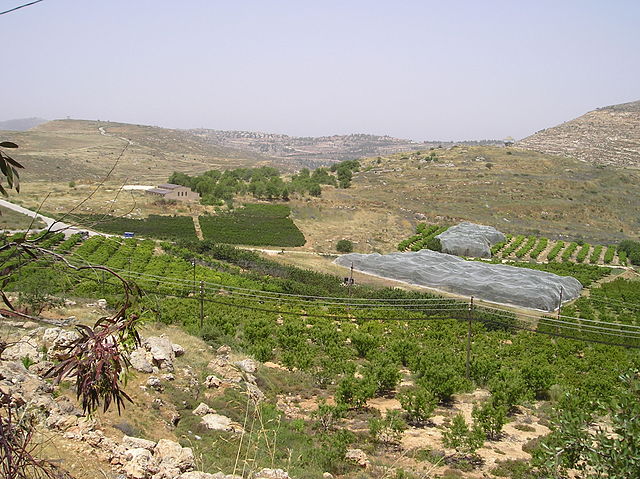
Tel Shiloh is believed to have been the site of the biblical tabernacle, but not everyone is pleased at how the ruins are presented to visitors. (File Photo By Abraham Sobkowski OFM/Wikimedia commons, CC BY-SA 3.0)
Deep in the West Bank, Israeli settlers have transformed an archaeological site into a biblical tourist attraction that attracts tens of thousands of evangelical Christians each year.
Tel Shiloh is believed to have been the site of the biblical tabernacle, but not everyone is pleased at how the ruins are presented to visitors.
Like many Holy Land sites, Tel Shiloh sits at the confluence of competing narratives of archaeology, religion, and nationalism. Critics say the site promotes a narrow interpretation of history popular with Israeli settlers and their Christian supporters.
The hilltop mound, 20 miles (30 kilometres) north of Jerusalem in the Israeli-occupied West Bank, has been excavated by several archaeological missions, starting in 1922, and has yielded remains spanning over 3,700 years.
For centuries, Jews, Muslims, and Christians have associated the site with the home of the biblical tabernacle, the portable shrine where the Israelites housed the Ark of the Covenant.
Because of its biblical significance, the archaeological ruins have become a pilgrimage site for evangelical Christians.
Last week, Prime Minister Benjamin Netanyahu visited Tel Shiloh with former Arkansas Gov. Mike Huckabee and settler leaders, calling it Israel’s “first capital.”
Huckabee, a television host with a strong evangelical following, tweeted that “Shiloh is proof from 3000 yrs ago this land was home to ?Israel site of ancient Tabernacle.”
In 2009, Tel Shiloh hosted 30,000 visitors, 60 per cent of whom identified as evangelical Christians, according to the Israeli government. In 2012, the government allocated about $4.2 million for a plan to preserve and upgrade the site, inaugurating a new visitors’ centre the following year.
Since its completion, Tel Shiloh — rebranded as Ancient Shiloh: City of the Tabernacle — has seen tourism skyrocket to around 120,000 visitors in 2018, said site director Lilyan Zaitman. Over half were evangelical Christians.
Unlike other major sites in the West Bank, Tel Shiloh is managed by the local settler council and Mishkan Shiloh, a private non-profit organization, rather than Israel’s Nature and Parks Authority.
The site is inside the Jewish settlement of Shiloh, founded after Israel captured the West Bank in the 1967 war. The tourist attraction is built on private Palestinian land but Palestinians are barred from entering, according to a recent Amnesty International report.
The Palestinians have demanded the West Bank as part of their future state, and most of the international community views the settlements as illegal.
The Second Protocol of the Hague Convention for the protection of cultural property prohibits archaeological excavations in occupied territory “save where this is strictly required to safeguard, record or preserve cultural property.” Israel is not one of the protocol’s 82 signatories.
Zaitman said visitors should understand that “the roots of the Jewish people began here,” calling it “the first capital city of the Jewish people before Jerusalem.
“
Despite Tel Shiloh’s long and varied history, the site drives home its Jewish relevance, with little attention paid to other periods or peoples, whether Canaanite, Byzantine or Muslim. This has drawn criticism from archaeologists and activists.
Emek Shaveh and Yesh Din, Israeli NGOs, charged in a 2017 report on Israeli archaeology in the West Bank that Ancient Shiloh aims to “reinforce the connection between the biblical Shiloh and the modern settlement, in a manner not necessarily based on the archaeological discoveries at the site.”
The goal, they argue, is to “create a broad consensus about its importance as an indivisible part of the state of Israel.”
Among the ruins are three Byzantine-era churches and two mosques. One of the two historical mosques is located outside the archaeological park, while the second is unmarked and undeveloped for visitors. A Byzantine church has been reconstructed and serves as a venue for events.
A new three-dimensional “hologram” presentation entertains viewers with a representation of the tabernacle and a description of the rituals performed there, based on the Bible.
A small museum inside the visitors’ centre makes scant mention of nearly 1,400 years of Muslim rule, and a film depicting the site’s history deals exclusively with the biblical account.
The archaeological record, however, is more complicated.
Tel Aviv University archaeologist Israel Finkelstein led excavations at Tel Shiloh in the 1980s. He said there is evidence of continuous religious activity at the site for centuries leading up to the early Iron Age, the period associated with the emergence of the ancient Israelites.
“What exactly was the nature of the cult, whether there was a temple there, and also the exact location of this cult place at the site, is not very clear,” Finkelstein said. As with any archaeological site, Finkelstein said “our responsibility is to give the facts, and then we can of course say that there is more than one way to interpret the finds.”
No evidence of the tabernacle has been found, but archaeologists are looking. Excavations are being carried out by the Associates for Biblical Research, whose stated aim is “demonstrating the historical reliability of the Bible through archaeological and biblical research.”
Scott Stripling, head of the current excavation, is one of a handful of evangelical archaeologists currently excavating in the West Bank. Evangelicals are the only non-Israeli teams involved in West Bank digs. Except for Tel Shiloh, however, the others operate in conjunction with Israeli universities.
“We will likely be the largest excavation in Israel once again this summer,” Stripling said. Despite broad academic stigma involved with excavating in the West Bank, Stripling said his organization “is completely apolitical, and we would be excavating the same region, regardless of political changes.
“
Rico Cortes, a tour guide from Orlando, Florida, who led a Spanish-speaking group through the site earlier this month, said Shiloh’s connection to the state of Israel is unquestioned.
“I bring everyone to respect Israel, the people and the Book,” he said. “The fact that the presence of God one time dwelled here is overwhelming.”




















