Connect with us

Headline

Puerto Rico health officials declare chikungunya epidemic as virus spreads in Caribbean

Published

on

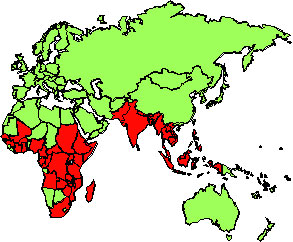
Cases of chikungunya fever (between 1952 and 2006) have been reported in the countries depicted in red on this map. Since 2006, local transmission has occurred in areas within Taiwan, Australia, and the Caribbean. Photo from Wikimedia Commons.

Cases of chikungunya fever (between 1952 and 2006) have been reported in the countries depicted in red on this map. Since 2006, local transmission has occurred in areas within Taiwan, Australia, and the Caribbean. Photo from Wikimedia Commons.

SAN JUAN, Puerto Rico—Health officials in Puerto Rico on Thursday declared an epidemic of the mosquito-borne virus known as chikungunya, which was introduced into the Caribbean region late last year.

Health Secretary Ana Rius said that more than 200 cases had been confirmed on the island as of June 25 and that the majority of them were reported in the capital of San Juan and nearby areas.

The first case of chikungunya in the U.S. territory was reported in late May.

Also on Thursday, officials in Jamaica reported the island’s first confirmed case. The chief medical officer, Dr. Kevin Harvey, said the virus was found in a person who had recently travelled to a country where there have been locally transmitted cases.

In Florida, health officials reported the first domestically acquired chikungunya infections in the United States. Officials said it happened in two cases, both of which involved a person infected with the virus after visiting the Caribbean being bitten again by an uninfected mosquito in Florida, which then transmitted the illness further.

Across the Caribbean, the Pan American Health Organization recorded more than 354,000 suspected and confirmed cases as of July 11. The Western Hemisphere’s first locally transmitted case was confirmed in December in the French Caribbean territory of St. Martin.

Chikungunya was first identified in Africa in 1953.

It causes a high fever and severe pain in the joints, but is rarely fatal. There is no vaccine, and it mainly is treated with pain medication.


Continue Reading
Click to comment

Leave a Reply

Your email address will not be published. Required fields are marked *

Maria in Vancouver

Headline6 days ago

Living With Anxiety: The Invisible Weight We Carry

There are illnesses we can see, and then there are the ones we learn to hide. Anxiety is often one...

Headline3 weeks ago

The Art of A Slow Weekend

We live in a world that glorifies being busy. Some people wear exhaustion like a badge of honour. Calendars are...

Headline1 month ago

Why We Chose an Intimate Wedding — And Why More Couples Are Doing the Same

Every wedding anniversary takes me back to one of the most magical days of our lives and reminds me why...

Headline1 month ago

Celebrating Turning 58

Birthdays have a way of making us pause—not to count the years we’ve lived, but to appreciate the countless blessings...

Lifestyle2 months ago

The Painful Reality of Losing Someone

Recently, I experienced the painful reality of losing someone through others. One friend lost her fiancé to death, while another...

Headline2 months ago

The Sobering Reality of Growing Old

Growing old brings a sobering reality: time is finite.  You watch your body slow down, see your parents age, and...

Lifestyle3 months ago

Dr. David Suzuki’s Legacy: A Celebration at 90

Celebrating Dr. David Suzuki’s 90th birthday on Friday, May 22  was a true privilege and a great pleasure! My husband,...

Lifestyle3 months ago

What I Know Now About Motherhood

Did you know that a mother’s cells can live in her child’s body for their entire lives? This fascinating phenomenon...

Headline4 months ago

Age with Audacity

At 25, I imagined life at 50 would mean I’d be past my prime and grumpy.  Little did I know,...

Lifestyle4 months ago

Spring Clean Your Body, Mind and Home

Spring has sprung! This season is perfect for spring cleaning, but why stop at our homes?  We can also rejuvenate...