Lifestyle
Five things you need to know about polyamory

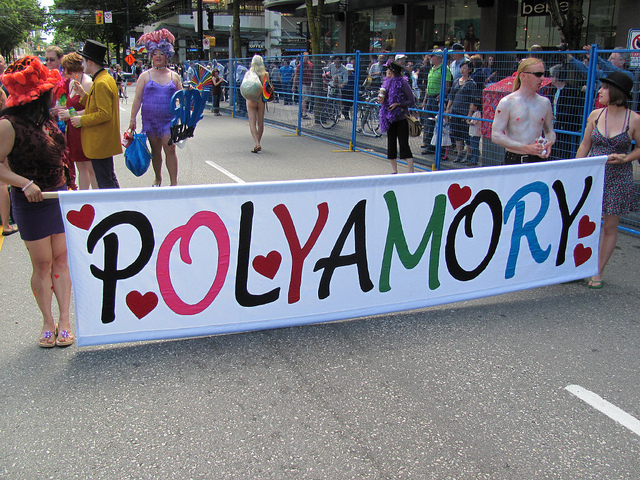
“Polyamorous relationships have been in the open since the late 1960s, but it has really picked up steam in the last 10 years,” Boyd says. (Photo by Robert Ashworth/Flickr, CC BY 2.0)
This week, a court in Newfoundland and Labrador recognized three unmarried adults as the legal parents of a child born within their “polyamorous” family. It was believed to be a legal first in Canada. However, many Canadians were left with one big question: What does polyamorous mean? Here’s five things you need to know:
- There is no definitive definition, but there are a few basic principles.
The term appears to have emerged in the early 1990s, but there is no single definition that has universal acceptance.
John-Paul Boyd, executive director of the Calgary-based Canadian Research Institute for Law and the Family, says people who consider themselves polyamorous prefer to have intimate relationships that involve more than two people, where marriage is not considered necessary.
And there’s an added dimension that typically involves a high degree of openness and trust about the voluntary arrangement.
“Polyamorous relationships have been in the open since the late 1960s, but it has really picked up steam in the last 10 years,” Boyd says.
Those who describe themselves at polyamorous typically reject the notion that exclusivity is required for long-term, loving relationships.
- Polyamorous relationships have nothing to do with bigamy or polygamy.
Under Section 293 of the Criminal Code, it is illegal to be married to more than one person. Polyamorous relationships do not violate that provision of the law.
However, it would be wrong to assume that is the only difference between polygamy and polyamory.
Last July, two men in British Columbia were found guilty of polygamy. Winston Blackmore, 62, was married to two dozen women, while James Oler, 54, was found to have married five women. Both are leaders of the Fundamentalist Church of Jesus Christ of Latter-day Saints in Bountiful, B.C.
Boyd said these arranged marriages were part of a patriarchal structure that led to “serious, negative social effects within that community.”
“They were mandated by God and there’s no pretence of equality,” he said. “And it’s mandatory.”
By contrast, polyamorous relationships are voluntary.
“The key is that whatever (polyamorous) relationships look like, they are consensual,” he said. “Everybody knows what’s going on. Honesty and transparency are at the core of it all.”
Boyd said his research has found that among those who consider themselves polyamorous, there’s a heavy emphasis on equality, regardless of gender, sexual identity and parenting status.
- We really have no idea how many people are polyamorous, but there has been some fascinating research.
There’s no way of knowing how many Canadians consider themselves polyamorous. Statistics Canada doesn’t collect that kind of data.
However, a 2009 American study suggested that one in 614 Americans lived in openly polyamorous relationships. Another U.S. study the following year suggested about one in 500 Americans described themselves as polyamorous.
In 2016, Boyd used social media to ask polyamorous Canadians to take part in an online survey. More than 500 people responded.
“That’s a huge number,” he says. “Getting people to fill out surveys is like pulling teeth.”
Of the 480 responses that were analyzed, 82 per cent agreed that the number of people who identify as polyamorous in Canada is increasing.
Meanwhile, the website for the Canadian Polyamory Advocacy Association includes more than 100 links to sites for advocacy, support and dating.
- Polyamory is not just another term for what “swingers” do.
According to the Electronic Journal of Human Sexuality, there’s a big difference between swingers and those who are polyamorous.
Swinging is non-monogamous sexual activity “treated much like any other social activity,” says an October 2000 paper published in the journal, titled “Today’s Alternative Marriage Styles: The Case of Swingers.”
“Emotional monogamy, or commitment to the love relationship with one’s marital partner, remains the primary focus.”
By contrast, those who are polyamorous may not be interested in sex: “It’s just consensual non-monogamy,” says Boyd.
Polyamorous relationships emphasize emotional and egalitarian aspects, while swingers focus on sexual non-monogamy and emotional monogamy.
That said, a polyamorous person may engage in swinging, while swingers sometimes develop emotional bonds with their sexual partners.
- Children are frequently part of polyamorous families.
The data compiled from Boyd’s 2016 survey showed that 40 per cent of respondents said there were children living in their homes full- or part-time.
“What that shows is that it is hardly uncommon for people to have children in their polyamorous relationships,” Boyd says.
Still, the recent case in Newfoundland and Labrador drew attention to the fact that the law hasn’t kept up with the evolution of Canadian families.
In that case, released Thursday, the St. John’s family included two men in a relationship with the mother of a child born in 2017. The adults had been together for three years, but the biological father of the child was unknown.
In his decision, Justice Robert Fowler of the provincial supreme court said: “Society is continuously changing and family structures are changing along with it. This must be recognized as a reality and not as a detriment to the best interests of the child.”