
News
Sri Lanka declares emergency amid anti Muslim violence

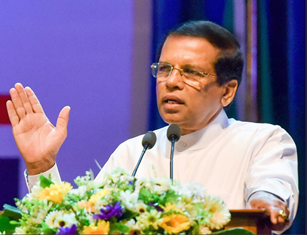
A tweet from the office of President Maithripala Sirisena said the decree would “redress the unsatisfactory security situation prevailing in certain parts of the country.” It said the country’s security forces “have been suitably empowered to deal with criminal elements in the society and urgently restore normalcy.” (Photo: Maithripala Sirisena/Twitter)
COLOMBO, Sri Lanka – Sri Lanka’s president declared a state of emergency Tuesday amid fears that anti-Muslim attacks in several central hill towns could spread.
Details of the emergency decree were not immediately announced, and it was unclear how it would affect life on the South Asian island nation, where Buddhist-Muslim tensions have flared in recent years with the growth of extremist Buddhist organizations. Life went on as normal Tuesday afternoon in the capital, Colombo, and many other towns and cities, with no signs of increased security.
The areas where the violence erupted Monday, outside the town of Kandy, remained under curfew Tuesday, with soldiers and police patrolling the streets and no one allowed outside except for emergencies.
A tweet from the office of President Maithripala Sirisena said the decree would “redress the unsatisfactory security situation prevailing in certain parts of the country.” It said the country’s security forces “have been suitably empowered to deal with criminal elements in the society and urgently restore normalcy.”
While government officials did not specifically mention Buddhist extremists, many comments appeared aimed at them.
The government will “act sternly against groups that are inciting religious hatred,” Cabinet minister Rauff Hakeem said after a meeting with the president.
The emergency announcement came after Buddhist mobs swept through the towns outside Kandy, burning at least 11 Muslim-owned shops and homes. The attacks followed reports that a Buddhist man had been killed by a group of Muslims. Police fired tear gas into the crowds, and later announced a curfew in the town.
So far no violence has been reported in other parts of the island nation.
Lakshman Kiriella, a lawmaker from Kandy, said in Parliament that the attacks were “carried out by outsiders.”
“I am ashamed as a Buddhist and we must apologize to the Muslims,” he declared.
Prime Minister Ranil Wickremesinghe said the government condemned the “racist and violent acts.”
“As a nation that endured a brutal war we are all aware of the values of peace, respect, unity and freedom,” he said on Twitter.
Sri Lanka has long been divided between the majority Sinhalese, who are overwhelmingly Buddhist, and minority Tamils who are Hindu, Muslim and Christian. The country remains deeply scarred by its 1983-2009 civil war, when Tamil rebels fought to create an independent homeland. While the rebels were eventually crushed, a religious divide has taken hold in recent years, with hard-line Sinhalese groups accusing Muslims of forcing people to convert and destroying sacred Buddhist sites.
The U.S. Embassy urged the government to act quickly against the perpetrators, protect the rights of religious minorities and “conclude the state of emergency swiftly, while protecting human rights and basic freedoms for all.”
The rights group Amnesty International said the state of emergency should not be a pretext for further human rights violations, given that the country has spent nearly 40 years since independence under emergency rule.
“While it is positive that the government wishes to prevent further violence, any steps taken to address the problem, however, must meet Sri Lanka’s obligations under international human rights law, including the absolute prohibition on torture, unfair trials and arbitrary detention,” said Biraj Patnaik, the group’s South Asia director.




















