News
South Korea moves to boost weaponry amid threats from North


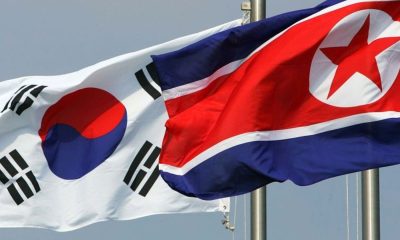
FILE: Flag of South Korea (Photo: By Various – Ordinance Act of the Law concerning the National Flag of the Republic of Korea, Public Domain)
SEOUL, Korea, Republic Of — South Korean President Moon Jae-in took office four months ago with plans to reach out to North Korea in a way his conservative predecessors did not in the previous decade. Two ICBM launches and one nuclear test later, his government is ramping up its defences, with some officials even considering asking the United States to bring back tactical nuclear weapons a generation after their removal from the Korean Peninsula.
Seoul’s new interest in stronger weapons received a boost Tuesday when the Trump administration agreed to remove previous restrictions on South Korean missiles.
But South Korean hunger for military strength goes beyond just missiles. Government officials also endorse the nation getting nuclear-powered submarines. And Seoul’s defence minister says the idea of bringing back U.S. tactical nukes to South Korea should be “deeply considered” by the allies.
This shift right by the liberal Moon underscores deep unease that the North’s expanding nuclear weapons arsenal will undermine the country’s decades-long alliance with the United States. Pyongyang may soon perfect an intercontinental ballistic missile that can target the U.S. mainland.
Here are some of the military capabilities South Korea is pursuing or may soon:
___
BALLISTIC MISSILES
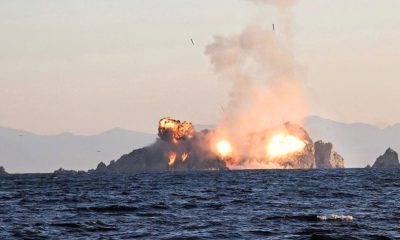
South Korea says stronger missiles are crucial to the so-called “kill chain” pre-emptive strike capability it wants to use to target North Korea. A pre-emptive strike against Pyongyang’s leadership would be difficult to undertake, but it’s widely seen as the most realistic of the limited military options Seoul has to deny a nuclear attack from its rival.
In August, South Korea conducted the last scheduled flight test of a new missile with a range of 800 kilometres (500 miles). It will soon join the “Hyunmoo” family of ballistic missiles that currently have a maximum range of 500 kilometres (310 miles).
While Seoul’s military says its missiles are currently capable of wiping out North Korean structures on land, it says heavier warheads are needed to target North Korea’s underground facilities and bunkers.
Following North Korea’s second test of an ICBM in July, Moon ordered his military to schedule talks with the United States to increase warhead weight limits on South Korea’s maximum-range missiles. Moon’s office didn’t announce any changes to the range limit on Tuesday.
South Korean missile developments have been constrained by a bilateral guideline between the allies since the late 1970s, when Washington sought to check Seoul’s missile development under military dictator Park Chung-hee, a staunch anti-communist who ruled South Korea in the 1960s and ’70s. The restrictions have been eased over the years.
___
NUCLEAR-POWERED SUBS
Several South Korean government officials, including Prime Minster Lee Nak-yon, the country’s No. 2, have been calling for South Korea to acquire a nuclear-powered submarine. South Korea’s navy is planning a feasibility study over getting such vessels, although some experts see the possibility as low.
Supporters say such vessels are critical for coping with North Korea’s submarine-launched ballistic missile system because they can operate much longer than conventional diesel-powered submarines without refuelling . That gives them a better chance to find and track North Korean subs, they argue.
In August last year, the North successfully test-fired for the first time a submarine-launched ballistic missile that flew about 500 kilometres (310 miles). Such technology in the hands of North Korea is an alarming thought for South Korea and Japan because such weapons are harder to detect before launch.
If South Korea makes a real push for nuclear-powered subs, critics say it may never overcome political and technical hurdles. Washington may also balk at Seoul’s acquisition of the enriched uranium needed to operate such submarines. Critics also argue that Washington already provides its ally a nuclear umbrella of protection and can easily ship in assets to detect and contain North Korean submarines when needed.
___
TACTICAL NUKES
Experts say South Korea would have an even harder time persuading the United States to re-introduce tactical nukes to the Korean Peninsula. These were withdrawn in the 1990s.
Even so, that hasn’t stopped lawmakers from South Korea’s largest conservative party from demanding the return of the weapons. Song Young-moo, Seoul’s defence minister, told lawmakers Monday that the allies should consider the issue.
South Koreans who support the return of U.S. tactical nukes often raise fears of rifts in the decades-old security alliance between Washington and Seoul because of North Korea’s expanding nuclear weapons program.
If North Korea obtains a fully functional ICBM, the United States might hesitate using its nuclear weapons to defend South Korea because of worries that North Korea might then strike a U.S. city, they say. Placing U.S. tactical nuclear weapons in South Korea would make clear the intent to use nukes in a crisis.
Critics say it’s highly unlikely the United States would ever agree because it now relies on homeland and sea-based military assets to provide its allies extended nuclear deterrence. Some South Korean military experts say the nukes wouldn’t meaningfully improve the South’s defence and would only provide North Korea more targets to destroy or even attempt to steal.