Canada News
Why provincial cabinets deserve more attention in Canadian politics

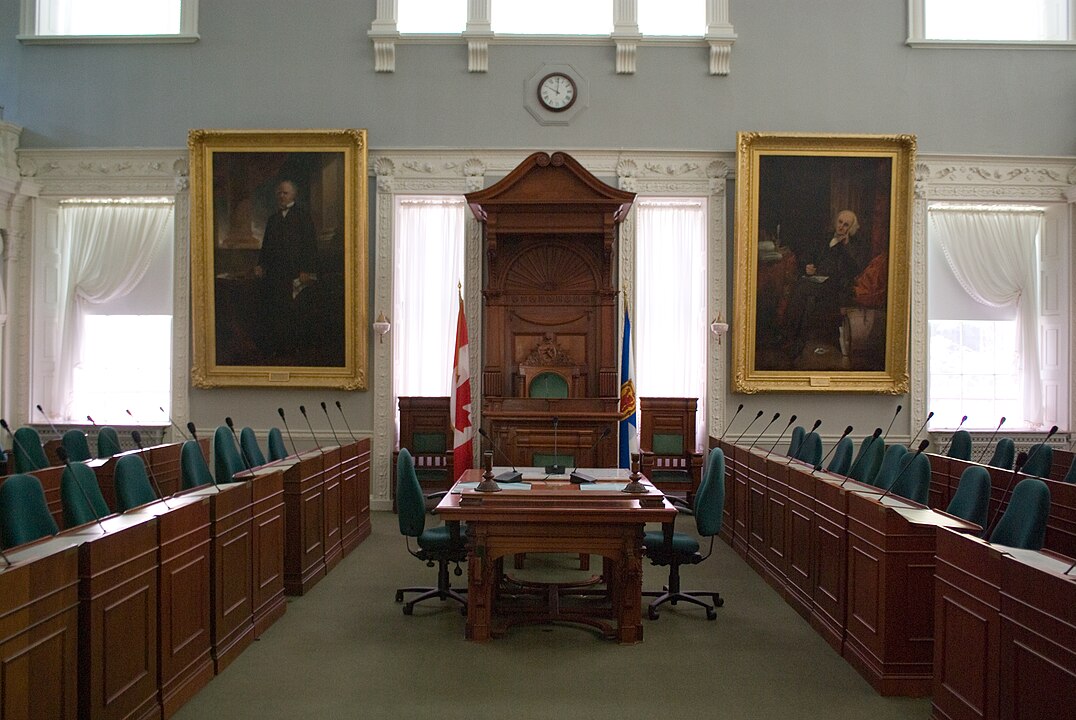
FILE: The Assembly Chamber is home to Nova Scotia’s House of Assembly since 1819. The seat in the center is used by the Speaker, while the seats on the left are used by the governing party (the Progressive Conservatives at the time this was taken) and the seats on the right are used by opposition parties (the NDP and the Liberals). The portrait on the left is of Joseph Howe. (Photo By Charles Paul Hoffman /Wikimedia Commons, CC BY-SA 3.0)
While intergovernmental relations are never too far below the surface in Canadian politics, the last few months have been notable for the high public visibility of first ministers.
With a united “elbows up” posturing in response to U.S. President Donald Trump and a new Canadian prime minister seemingly ready to engage with the provinces and territories in the interest of economic development, premiers across the country have been working at high speed.
But do all political executives in Canada work the same way?
No, and more study is needed on provincial and territorial cabinet governance to understand these differences and why they matter.
For example, Professor Donald Savoie has spent a career helping us understand how political executives function and is one of a handful of Canadian political scientists whose research is known outside the university classroom.
Very little of his research, however, touches on the subnational level. In fact, Savoie’s focus is reflective of Canadian political science and the media, both of which fix their gaze on federal rather than provincial politics – even though provinces hold tremendous political power and are responsible for some of the most critical social services.
The overlooked power of provincial cabinets
In the past 40 years, only a handful of books have been dedicated to provincial cabinet governance, although there is a lot to understand about premiers and their cabinets.
Some have argued that within their own jurisdiction, premiers are more powerful than the prime minister, although the latter’s office is routinely described as having much more autocracy and potential for centralization than other Westminster-style cabinets around the world.
They also say that within legislatures, the provincial cabinet can be more powerful than the federal cabinet vis-à-vis Parliament.
With a major gap in research on cabinet governance and a convincing case for why we should understand more about this part of the Canadian political system, our ongoing study analyzes the evolution of cabinet systems at the subnational level.
We have long-term plans to study all 10 provincial and three territorial cabinet systems, but we began in Atlantic Canada – New Brunswick, Nova Scotia, Prince Edward Island, and Newfoundland and Labrador.
Lessons from Atlantic Canada’s political “small worlds”
Atlantic Canada has a long history of responsible government influencing modern cabinet governance. Responsible government – where cabinet is drawn from the elected legislature – was first introduced in Canada in colonial Nova Scotia in 1848.
In 1980, David Elkins and Richard Simeon edited the collection, Small Worlds: Provinces and Parties in Canadian Political Life. The “small worlds” thesis suggests that each province is its own distinct political world.
Critics pushed back on their argument, but the “small worlds” theory still provides a useful starting point when comparing provincial and territorial politics. In focusing on Atlantic Canada, we were interested in finding out whether and to what extent these small provinces can also be understood as small political worlds.
Due to confidentiality and secrecy rules, the most powerful institution in the Canadian political system – cabinet – is arguably the most challenging to study because first-hand accounts and data are difficult to access.
Why cabinet governance research matters
A surface level review of contemporary Atlantic Canadian politics suggests each province has experienced similar stages (not necessarily in order) of cabinet government evolution.
All have experimented with varying forms of cabinet institutionalization (formalizing cabinet decision-making with degrees of committee work); cabinet support (political staffing); and cabinet size and structure.
Trust in government a key factor in acceptance of greater federal use of AI
Chrystia Freeland’s resignation points to final breakdown of cabinet government
Ministerial mandate letters are a nail in the coffin of cabinet government
Each province also has an example of a long-serving premier – Danny Williams in N.L., Pat Binns in P.E.I., Stephen McNeil in N.S. and Bernard Lord in N.B. – who have left more lasting marks on cabinet governance.
In our research, we are attempting to dig deeper than such surface-level similarities and differences to identify larger trends or disruptions in process and structure. While there is more research to do, we know that in Atlantic Canada:
- Premiers centralize and delegate power at their own prerogative and ministers serving under them evaluate their boss’s leadership and management style through their own personal lens.
- Personality and political context drive premier and cabinet behaviour, which can have a major impact on when a minister is shuffled, resigns or stays put in the face of policy failure or political scandal.
Some have argued that factors such as these which we found in Atlantic Canada allow some premiers to centralize power even more than the prime minister in Ottawa.
This argument is centred on a number of factors that allow premiers to dominate their political arena including smaller legislatures, less experienced legislators and less populated jurisdictions which allows the premier to appeal more directly to voters.
We believe these differences matter to how politics work in Canada and that greater attention to Canada’s political executives at all levels is needed.
This article first appeared on Policy Options and is republished here under a Creative Commons license.