Business and Economy
The U.S. economy is thriving in spite of tariffs. Will it last?

By Peter Armstrong, CBC News, RCI
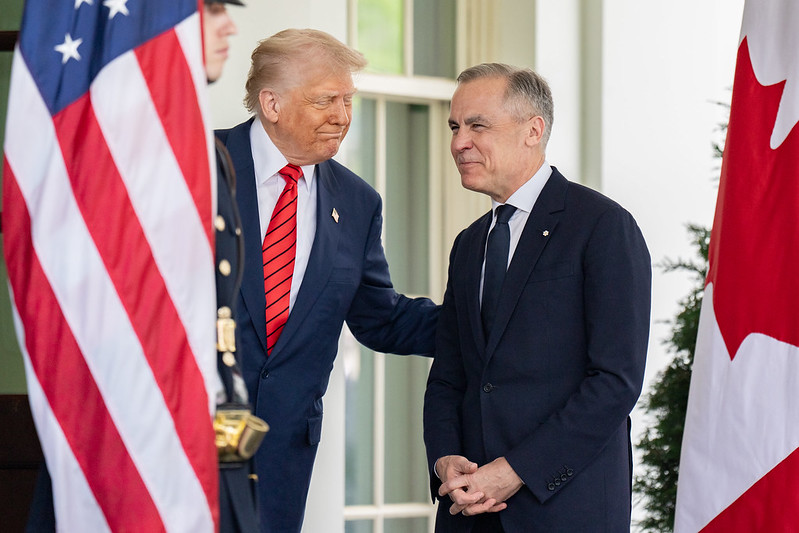
FILE: President Donald Trump greets Prime Minister of Canada Mark Carney, Tuesday, May 6, 2025, at the West Wing entrance of the White House. (Official White House Photo by Gabriel B Kotico via The White House/Flickr, United States government work)
By just about every indicator, the U.S. economy is holding up remarkably well. When Donald Trump launched his global trade war, economists and markets said his tariff policy would slow the economy, drive up prices and dramatically reduce global trade.
And yet, stocks are at all-time highs, the country’s employment is strong, its economy is expanding and the expected surge in inflation hasn’t materialized.
Canada’s economy has shown surprising resilience, as well, with consumer spending starting to pick up last month and unemployment declining.
Economists told CBC News it’s unclear whether the tariffs’ impact was overestimated, or if further pain lies ahead. But they say resilience in both countries is fragile, and could be quickly upended if the trade war worsens or expands.
A lack of retaliation
BMO’s chief economist Douglas Porter says two key factors are driving the recent U.S. resilience.
Other nations have not really been retaliating against the U.S., so their own exports are not facing that much pressure. And on the flip side, the U.S. consumer has been pretty heavily sheltered so far from this,
said Porter.
In the meantime, American businesses have not passed on the costs of tariffs. General Motors, for example, released earnings last week that said Trump’s tariff policies drove down profits by 35 per cent in the second quarter. The automaker said tariffs on cars and parts led to a $1.1-billion US loss in its quarterly earnings.
But still, it has not increased prices.
Royce Mendes, managing director at Desjardins Capital Markets, says that’s becoming a trend among affected American companies.
Some companies may choose to just eat the tariff increase in costs rather than draw the ire of President Trump,
said Mendes.
GM stock fell on the news, but has since rebounded, paring losses and climbing almost all the way back to where it was before it published its earnings.
Financial markets have had some pretty volatile sessions, including steep sell-offs when tariffs are announced, and big rallies when exemptions are made. But stock markets in both Canada and the U.S. are at or near record highs — which investors believe is a sign that the resilience we’re seeing will last.
A stockpile of products
The question, though, is whether the impact of the tariffs has simply been delayed.
When the levies were first announced last spring, businesses around the world scrambled to get product out the door and into the United States. That has led to a huge stockpile of products — and it means American importers have not yet had to bear the worst of the tariffs.
WATCH | The future of Canada-U.S. free trade:
There was a lot of front-running and that may be one of the big reasons why we haven’t seen much impact yet,
said BMO’s Porter. There’s probably some pain to come, but I don’t think it’s going to be as bad as many economists were fretting about earlier this year, at least for the U.S.
Canada’s economy has shown resilience, too
But both economists point to the fact that Canada’s economy has also fared better than almost anyone had expected.
Economic growth shrank in April, but only by 0.1 per cent. Statistics Canada says another 0.
1 per cent decline is likely for May. (Those numbers will be confirmed on Thursday.) The unemployment rate has actually begun to decline since peaking in May at seven per cent.
And last week’s retail sales figures showed consumer spending had started to pick up again in June.
We’ve been pointing to this broader resilience in consumer spending,
said Claire Fan, a senior economist with RBC.
She says consumer sentiment plunged in the spring, at the height of the uncertainty. But since then, RBC crunched U.S. customs data and found exemptions for CUSMA-compliant products have dragged the average effective tariff rate all the way down to as low as 2.3 per cent.
It’s a reflection of President Trump’s overall strategy of coming out very aggressive early on, but then walking things back. I mean, the tariffs have not been as punitive for Canada as initially believed — nowhere close to it,
said Mendes of Desjardins.
Sector-specific pain
However, real damage has been done in sectors like auto, steel, aluminum and lumber. The concern now is that the carve-outs Canada has secured for CUSMA-compliant products won’t last.
Unless a trade deal is reached to significantly reduce U.S.-Canada tariffs by Aug. 1, when new U.S. tariffs are set to come into effect, we expect job losses and higher prices from tariffs to squeeze disposable income and cause households to tighten their purse strings,
wrote Michael Davenport, senior economist at Oxford Economics in a note to clients.
WATCH | Negotiations continue between Canada and the U.S.:
On the one hand, some in the Trump administration will look at the U.S. economy’s relative resilience as a reason to double down and push harder for more and more punitive tariffs.
But escalation wouldn’t just be bad for the Canadian economy.
Right now, most businesses and consumers on both sides of the border have been sheltered from the worst impacts of the tariffs.
That shelter depends on a fine and tricky balance of importers eating some costs, exporters dropping some prices and countries limiting retaliatory measures.
Upending that balance further comes with risks on both sides of the dispute.
This article is republished from RCI.