Headline
Canadian traveler yields over P164-M shabu at NAIA

By Christopher Lloyd Caliwan, Philippine News Agency
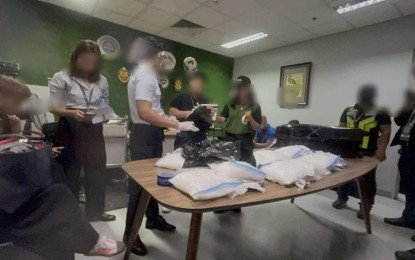
ILLEGAL DRUGS. Operatives from NAIA Inter-Agency Drug Interdiction Task Group examines PHP164.7 million worth of shabu found from the luggage of a Canadian national at the NAIA Terminal 3 in Pasay City on Monday (July 14, 2025). Authorities arrested the 66-year-old traveler from Toronto, Canada. (Photo courtesy of PDEA)
MANILA – Authorities arrested a female Canadian national after finding PHP164.7 million worth of shabu from her luggage at the Ninoy Aquino International Airport (NAIA) Terminal 3 in Pasay City, the Philippine Drug Enforcement Agency (PDEA) reported on Monday.
In a statement, the PDEA said alias “Grace,” 66, arrived from Toronto, Canada via Hong Kong on Monday when members of the NAIA Inter-Agency Drug Interdiction Task Group (NAIA-IADITG) flagged the Canadian national based on intelligence-driven efforts.
The operation was led by the PDEA Regional Office–National Capital Region, working closely with the Bureau of Customs, the Philippine National Police Aviation Security Group, the Airport Police Department, the PNP Drug Enforcement Group, the National Bureau of Investigation, and the Bureau of Immigration.
The operatives found the illegal drugs in three large garbage bags, weighing around 24,231 grams.
Initial field testing confirmed the substance as methamphetamine hydrochloride. Samples were secured and turned over to the PDEA Laboratory Service for confirmatory analysis.
Non-drug evidence recovered from the suspect’s belongings included a Canadian passport, two airline boarding passes, a mobile phone, an identification card, and a baggage declaration form.
The arrested passenger was informed of her constitutional rights and is now facing charges for Importation of Dangerous Drugs under Section 4, Article II of Republic Act 9165, otherwise known as the Comprehensive Dangerous Drugs Act of 2002.
The successful interdiction underscores the unwavering dedication of PDEA and its partner agencies to secure the nation’s borders against transnational drug smuggling. It also reflects the government’s intensified campaign to strengthen interdiction operations at all major ports of entry.