

By Michelle Bentley, Royal Holloway University of London; The Conversation
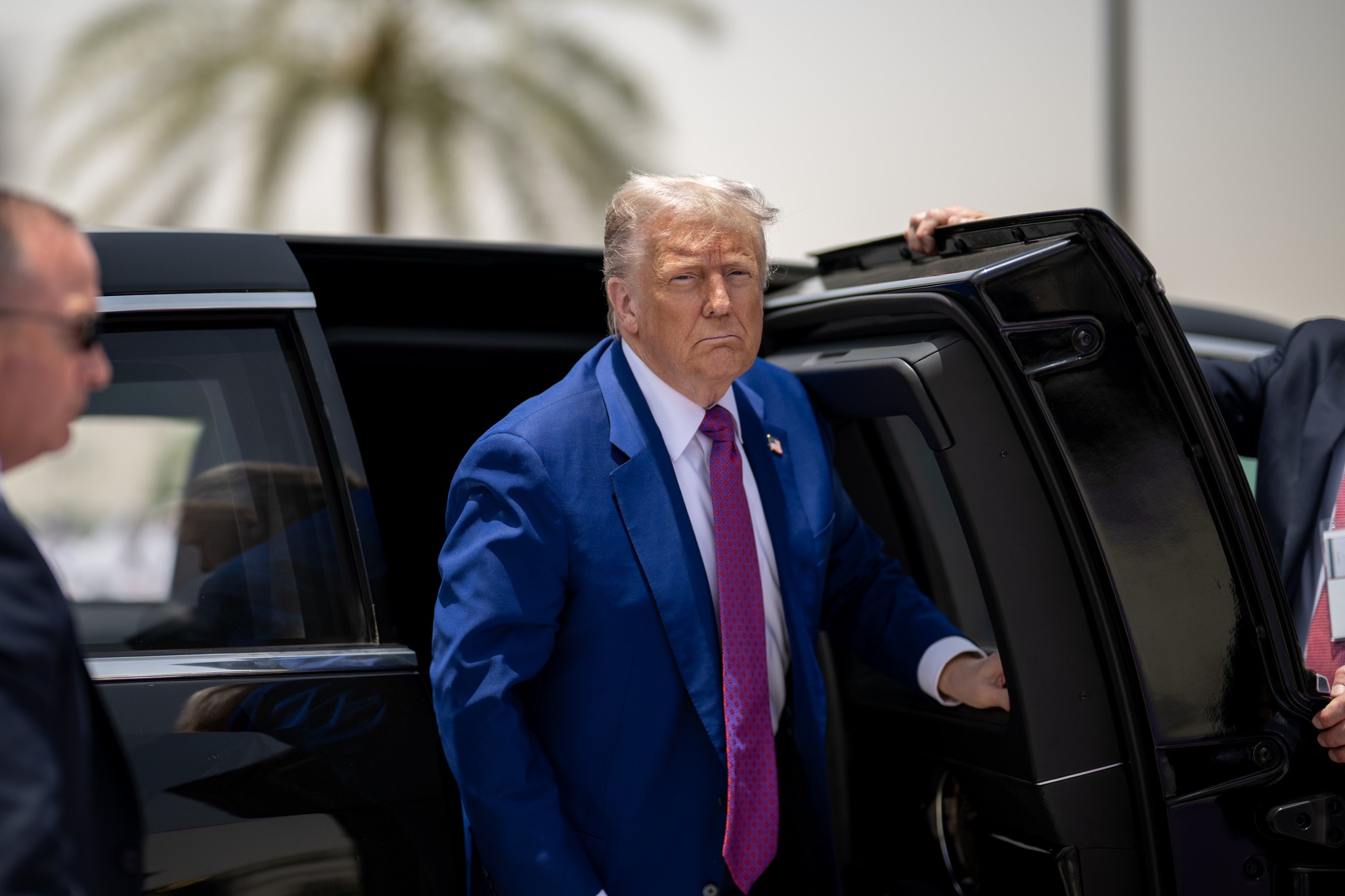
FILE: President Donald Trump participates in a welcome ceremony with Saudi Crown Prince Mohammed Bin Salman Al Saud at the Royal Court Palace in Riyadh, Saudi Arabia, Tuesday, May 13, 2025. (Official White House Photo by Daniel Torok; The White House/Facebook)
Donald Trump has dismissed reports that he has approved a plan of attack against Iran, and now says he will decide on US involvement within two weeks. This will only add to the speculation and confusion about what the president might do in response to the mounting conflict between Iran and Israel. And that’s exactly what Trump wants.
This is not a case of indecision or buying time. Trump has long based his foreign policy on being unpredictable. Iran is another example of his strategy to be as elusive as possible. Yet, his approach has always been difficult – and now threatens to destabilise an already fractious conflict.
One interpretation of Trump’s public threat towards Iran could be deterrence. Trump is warning Iran that there would be significant consequences if they do not reverse their nuclear ambitions. Change or you will regret it.
If this is Trump’s plan, then he is doing it badly. Successful deterrence relies on clearly communicating the exact penalties of not complying. While Trump has specified a possible attack on infamous underground nuclear facility at Fordow, the rest of the plan is extremely hazy. Trump said he wants “better than a ceasefire”.
Get your news from actual experts, straight to your inbox. Sign up to our daily newsletter to receive all The Conversation UK’s latest coverage of news and research, from politics and business to the arts and sciences.
But what does that mean? Just Fordow? Boots on the ground? Regime change? His ambiguity creates problems for deterrence because if your adversary doesn’t know what the outcomes of their actions will be, they can’t formulate a response or will think you just aren’t serious.
But current US foreign policy on Iran is more than bad deterrence. Trump’s vague rhetoric and his refusal to commit reflects his long-standing strategy of being unreliable when it comes to foreign policy.
Trump’s prevarication has all the hallmarks of his unpredictability doctrine – which states that you should never let anyone know what you will do. The doctrine is also about uncertainty. The idea being that you unnerve your opponents by making them unsure, allowing you to take the advantage while they have no idea what to do themselves.
Trump’s rhetoric on Iran reflects that unpredictability doctrine. Trump actively said of his future action: “I mean, nobody knows what I’m going to do.”
This would not be the first time he has used unpredictability in relation to Iran. In 2018, Trump withdrew the US from the joint comprehensive plan of action (JCPOA). This agreement – signed by the US, France, Germany, the UK, China, Russia and the EU – was designed to limit Iran’s nuclear activity in return for sanctions relief. The US withdrawal was seen as disruptive and creating unnecessary uncertainty, not just for Iran but also US allies.
Will the strategy work?
Being unpredictable is a dangerous way of doing foreign policy. Stable international politics depends on knowing what everyone else will do. You can’t do that with Trump.
The downsides of unpredictability will be even worse in a conflict. In the case of Iran, adding even more uncertainty to a fragile situation will only add fuel to what is already a massive fire.
Trump’s refusal to specify exactly what the US response would be is more proverbial petrol. The insinuation that this could escalate to regime change may be true or not (or just unpredictable bluster).
It’s also the case that only 14% of Americans support military intervention and so a more aggressive policy may not be realistic. But if Iran is led to think that Trump is directly threatening their state, this could encourage them to hunker down as opposed to changing their nuclear policy – risking greater military action on both sides.
Even just the implicit threat of US military intervention will damage what little relations there are between America and Iran. Iran’s supreme leader, Ayatollah Ali Khamenei, has said: “Any US military intervention will undoubtedly cause irreparable damage.” Unpredictability then undermines any diplomatic negotiations or solution to the crisis.
Trump is also risking his foreign policy relations beyond Iran. While preventing a new member of the nuclear club is a laudable aim, any US attack on a state over weapons of mass destruction (WMD) will lie in the difficult shadow of the “war on terror”, the US-led military campaign launched after 9/11.
With the International Atomic Energy Agency questioning Iran’s capacity to build a nuclear bomb, the US’s legacy of intervention over the WMD in Iraq that never were still looms large. Trump will need to be fully transparent and clear if any action over nuclear arms is going to be seen as legitimate. Unpredictability does not allow for that.
Trump’s fellow state leaders are going to feel disrupted by yet another example of unpredictability. Even if they support curbing Iran, they may find it difficult to back someone they simply can’t depend on. And if they feel cautious about the Iran situation because they can’t rely on Trump, Trump needs to start asking whether he can rely on them for support in whatever his next move is.
This article was amended on June 19 2025 to include Donald Trump’s denial of reports he had approved a plan of attack against Iran.
Michelle Bentley, Professor of International Relations, Royal Holloway University of London
This article is republished from The Conversation under a Creative Commons license. Read the original article.




















