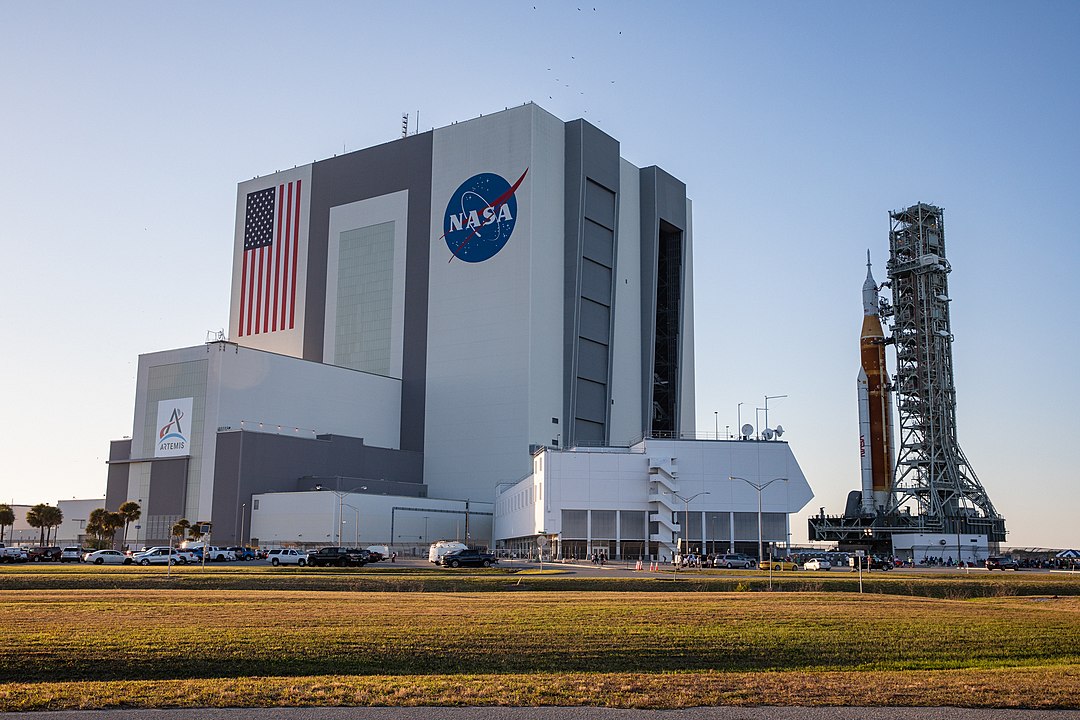
NASA’s Moon rocket is on the move at the agency’s Kennedy Space Center in Florida, rolling out of the Vehicle Assembly Building for a 4.2-mile journey to Launch Complex 39B on March 17, 2022. Carried atop the crawler-transporter 2, the Space Launch System (SLS) rocket and Orion spacecraft are venturing to the pad for a wet dress rehearsal ahead of the uncrewed Artemis I launch. The first in an increasingly complex set of missions, Artemis I will test SLS and Orion as an integrated system prior to crewed flights to the Moon. Through Artemis, NASA will land the first woman and the first person of color on the lunar surface, paving the way for a long-term lunar presence and serving as a steppingstone on the way to Mars. (File Photo By Kim Shiflett/Wikimedia Commons, Public Domain)
By Wendy Whitman Cobb, Air University, The Conversation
Over the past several days, NASA’s ambitious space exploration plans have experienced major setbacks. First, on May 30, 2025, newly released budget documents revealed the extent of the significant budget and personnel cuts proposed by the Trump administration. Then, just a day later, President Donald Trump withdrew the nomination of Jared Isaacman to be NASA administrator just days before an expected confirmation vote.
From my perspective as a space policy expert, these events signal problems ahead for a space agency that now faces stiff competition in space exploration from the commercial sector. Without a leader and facing a fight over its budget, NASA faces an uncertain future, both in the months ahead and longer term.
Budget problems
When the Trump administration released a preview of its budget proposal in early May, it was clear that NASA was facing significant cuts.
After receiving US$24.9 billion for 2025, the president’s proposal would allot NASA $18.8 billion in 2026. After accounting for inflation, this amount would represent NASA’s smallest budget since 1961.
Space science programs are one of the largest targets of the proposed budget cuts, seeing an almost 50% reduction, to just $3.9 billion. Specific programs targeted for elimination include the Mars Sample Return mission, the currently operating Mars Odyssey and MAVEN missions around Mars, and several missions to Venus.
Several ongoing and proposed astrophysics programs, including the Chandra X-Ray Observatory, would also end if the proposed budget passes.
NASA’s human spaceflight programs also face potential cuts. The budget proposes canceling the Space Launch System, the Orion crew vehicle and the Lunar Gateway following the Artemis III mission.
Artemis III, planned for 2027, would be the first crewed flight back to the lunar surface since 1972. The mission would use the Space Launch System rocket and Orion crew vehicle to get there. The proposed Lunar Gateway, a mini-space station in lunar orbit, would be abandoned entirely.
Instead, the budget proposes to establish a Commercial Moon to Mars program. Under this initiative, NASA would utilize commercial systems such as Blue Origin’s New Glenn and SpaceX’s Starship to put Americans on the Moon and Mars.

NASA, ESA, Zolt G. Levay (STScI)
A smaller budget also means a smaller NASA workforce. The budget proposal suggests that the number of NASA employees would be reduced by one-third, from more than 17,000 to 11,853.
Advocates for space science and exploration have criticized the cuts. The Planetary Society has stated that these cuts to space science represent an “extinction level event” that would all but end NASA’s ability to perform meaningful science.
Democrats in Congress were also quick to push back on the proposed cuts, arguing that they would hamper the U.S.’s ability to carry out its missions.
The budget documents released so far are just proposals. Congress must make the final decisions on how much money NASA gets and which programs are funded. While this might be good news for NASA funding, my research has shown that Congress rarely appropriates more money for NASA than the president requests.
Leadership challenges
The release of the president’s proposed budget was followed with the news that the president would withdraw his nomination of Jared Isaacman to be NASA’s administrator.
In a Truth Social post, Trump wrote, “After a thorough review of prior associations, I am hereby withdrawing the nomination of Jared Isaacman to head NASA. I will soon announce a new Nominee who will be Mission aligned, and put America First in Space.”
Like the budget proposal, news of Isaacman’s withdrawal has also hit the space community hard. Following his nomination, Isaacman won the support of many in the space industry and in government. His confirmation hearing in April was largely uncontentious, with support from both Republicans and Democrats.
NASA will now need to wait for the president to make a new choice for NASA administrator. That person will then need to go through the same process as Isaacman, with a hearing in the Senate and several votes.
Given the amount of time it takes for nominations to make their way through the Senate, NASA is likely to face several more months without a confirmed administrator. This absence will come while many of its programs will be fighting for money and their existence.
The months ahead
Like many federal agencies right now, NASA faces a tumultuous future. Budgetary and leadership challenges might be the immediate problem, but NASA’s long-term future is potentially rocky as well.
Since its founding, NASA’s mission has been largely centered on sending humans to space.
If that role shifts to commercial companies, NASA will need to grapple with what its identity and mission is going forward.
History provides some insight. One of NASA’s forerunners, the National Advisory Committee for Aeronautics, or NACA, largely focused on advanced research and development of aeronautical technologies. For instance, NACA researched things such as proper engine placement on airliners as well as advances that helped air flow more efficiently over those engines.
A new NASA that’s more similar to NACA might continue research into nuclear engines or other advanced space technology that may contribute to the work commercial space companies are already doing.
Choices made by the Trump administration and Congress in the coming months will likely shape what NASA will look like in the years to come. Until then, NASA, like many government organizations, faces a period of uncertainty about its future.
Wendy Whitman Cobb, Professor of Strategy and Security Studies, Air University
This article is republished from The Conversation under a Creative Commons license. Read the original article.