Lifestyle
Pope’s election inspires reflection, hope, hesitation

By Edison Joseph Gonzales, Philippine News Agency
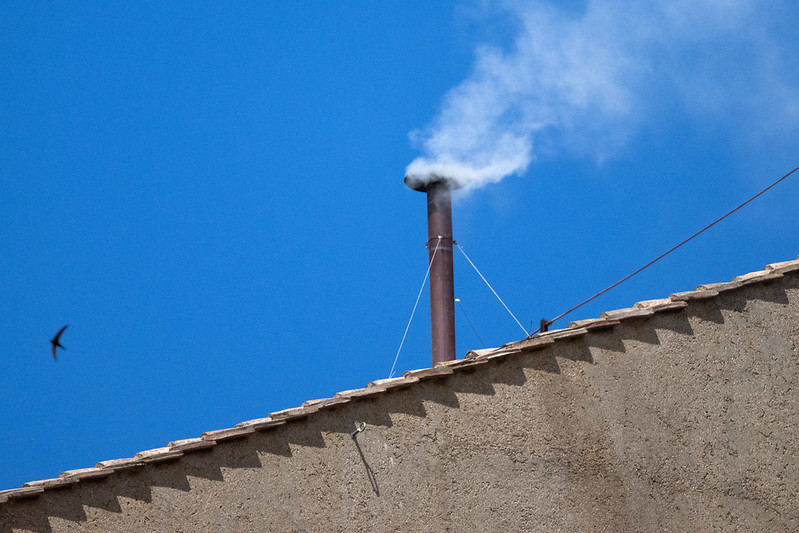
Conclave Day Two. (File Photo: Catholic Church England and Wales/Flickr, CC BY-NC-ND 2.0)
MANILA – As white smoke curled into the Roman sky and bells rang across St. Peter’s Square, Catholics around the world exhaled with anticipation and awe.
The election of a new pope is always historic, but for many, the announcement of Pope Leo XIV, formerly Cardinal Robert Prevost, a member of the Order of St. Augustine, carried deeper spiritual and personal meaning.
For many Catholics, the election brought a mix of awe, uncertainty and deeply personal reflection. In homes, chapels and digital watch parties around the world, faithful observers looked beyond the pageantry to the question that now defines a Church in transition — what kind of shepherd will this new pope be?
For Natalia Vasquez, an educator, watching the live coverage of the conclave was both moving and frustrating. While the solemnity of the event stirred reverence, the frenzy in online comment sections, filled with fans rallying behind favorite cardinals, struck a dissonant note.
“I couldn’t help but feel a tinge of embarrassment at how some of my fellow countrymen were spamming the feed, campaigning for their favored candidates as if it were a popularity contest,” she said.
Vasquez emphasized that the conclave is not a political campaign but a spiritual ritual guided, she believes, by divine wisdom.
“It is, at its very core, an act of profound spiritual discernment, a solemn listening for the gentle whisper of the Holy Spirit,” she said. “In a world obsessed with image, noise and immediacy, the Church reminds us that true leadership is not about being visible, it is about being chosen. Not by popularity, but by purpose.”
The sense of uncertainty was shared by many young Catholics, including Mika Dueñas, a university student whose curiosity about the conclave was sparked by a 2024 film dramatizing the process. She began reading extensively about the rituals and traditions and hoped that Pope Francis’ progressive legacy would continue.
“I was watching the announcement in my room, silently hoping that the new pope would be a progressive one just like the late Pope Francis,” she said. “It was a surprise when they named Pope Leo as I expected it to be one of the frontrunners.”
Dueñas, like many others, immediately searched online for information. What she found gave her pause. Articles were saying his views on LGBT were unclear and less supportive of the previous pope, she said. “Hopefully, his views have changed and were influenced by Pope Francis. A pope is basically a ruler — God’s messenger. Whatever his views are, progressive or not, they’ll be followed by Catholic churches around the world.”
That influence, the weight of papal decisions on everyday believers, was also on the mind of Erwin Vergara, another university student and a lector.
Initially unfamiliar with the key candidates, he followed the livestream out of growing interest, tuning in late on May 8.
“I had no idea about the frontrunners or the so-called dark horses,” he said. “The only ones I really knew were our own Cardinals Tagle and David.”
When the white smoke appeared, Vergara rushed back to the livestream. He was surprised by the outcome.
“I was still shocked when the dean announced that it was Cardinal Robert Prevost from the United States,” he said. “Maybe because he’s the first pope from there, or maybe because I honestly hadn’t heard anything about him before.”
He, too, read about concerns surrounding the new pope’s past leadership and theological leanings. But his faith remained intact.
“While he isn’t a Pope Francis or a Cardinal Tagle, I still believe that the Holy Spirit chose him for a reason,” he said. “My heart is filled with joy, because as someone who serves God through His word, the Catholic Church has a leader once again. I hope he chooses the people, like how God chose him.”
For Jannah Yap Capile, a university student in Manila and a longtime observer of Church dynamics, the papacy, more than a religious title, is an institution that holds power to shape culture, policy and personal identity.
“Catholicism, being one of the most influential religions in the world, holds the papal seat not just as a spiritual role, but one of global authority,” she said.
She praised Pope Francis for advancing inclusion and modernizing the Church’s pastoral tone, and she wonders if that trajectory will continue.
“His reign broke centuries of barriers while keeping the integrity and prominence of the holy seat,” she said. “The question is: Will the next pope continue the progress, or rebuild the barricades?”
Within the Augustinian order, however, the moment is one of profound pride. Pope Leo XIV is the first member of the Order of St. Augustine to assume the papacy, a historic first for the religious community that shaped him.
“Habemus Papam!” wrote the Rev. Dante Bendoy, OSA, provincial of the order’s Philippine province, in a message of thanksgiving. “Truly, this is a divine blessing, not only for the Order of St. Augustine but for the entire Universal Church.”
Bendoy remembered the pope’s visits to their communities across the Philippines, recalling his quiet leadership, pastoral presence and humility.
“He left a lasting impression on us,” Bendoy wrote. “Such a high calling is not without its crosses… but there is always grace on the cross. Through grace, we hope Pope Leo XIV will find the resilience, wisdom and compassion needed to lead the Church.”
Back in classrooms, dormitories and parish halls, the faithful continue to reflect. For some, the moment is charged with concern. For others, with cautious optimism. But for all, it marks a turning point not only in history, but in spirit.
“We watch history unfold,” Vasquez said. “But moments like these demand more than observation. They call for reverence. They call for awe. Because this isn’t just history. This is providence in motion. This is the Holy Spirit at work.”