Canada News
Refugee groups uneasy over decision to nix newcomer centres

By Emma Weller, CBC News, RCI
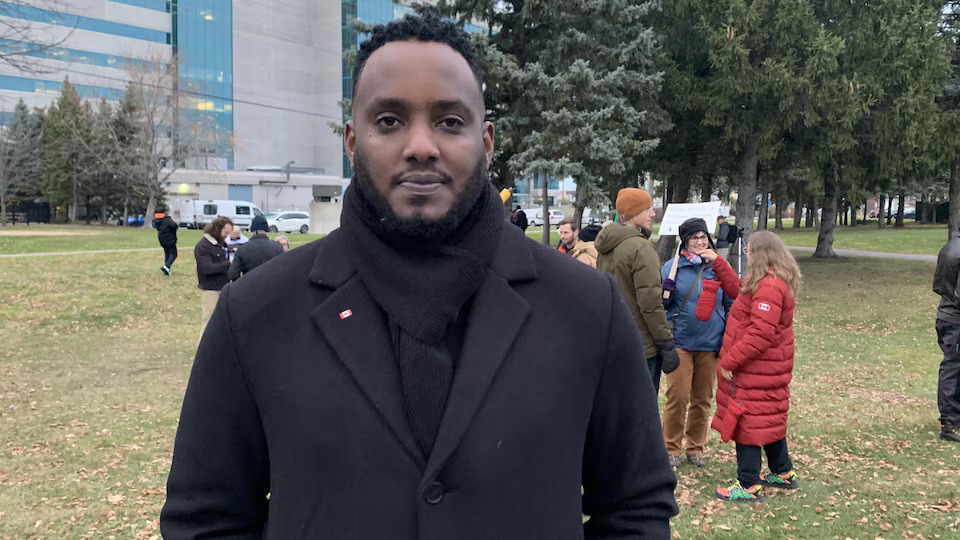
Camille Kamanzi, the executive director of Burundi We Want Ottawa, says last week’s decision by the city to terminate plans to potentially build two newcomer reception centres a big disappointment. (Antoine Fontaine/Radio-Canada) Photo: Radio-Canada / Antoine Fontaine
City cites shelter demand for newcomers down, but some advocates disagree
After months of fighting for tent-like reception centres to house asylum seekers in Ottawa, Camille Kamanzi says he’s filled with disappointment.
The city just let us down,
said Kamanzi, executive director of Burundi We Want Ottawa.
On March 12, the City of Ottawa announced it was cancelling plans to move forward with the controversial centres (new window) — one near the Nepean Sportsplex, and a second in Kanata if it was needed.
Their purpose was to be a one-stop shop for resettlement services. Newcomers would receive housing, food and social support for 90 days until they got a more permanent solution.
The plan was created in response to an influx of unhoused refugee claimants (new window), one that forced the city to shelter people in municipal recreation centres.
While the city says the demands posed by newcomers on the city’s shelter system has declined, Kamanzi disagrees.
To just eliminate that as if the problem is solved, I think it’s just beyond insulting to us,
he said, adding that his organization is overwhelmed with demand for resettlement support.
[This] just means more work for us.
‘Better service model’ needed
In 2023, Ottawa began seeing a significant and unprecedented increase in the number of asylum claimants accessing shelters,
according to a memo last week from interim director of housing and homelessness services Kale Brown.
That number peaked at around 1,000 asylum claimants but has since dropped to 820, Brown wrote.
However, Louise Ebeltoft, executive director of Carty House, a chain of transitional homes for refugee women, agrees the demand is still there.
All the people that work in the sector, whether you’re in settlement or housing, we all still see that there is a need for more beds and [a] better service model,
she said.
Kamanzi’s worries are long-term, and he doesn’t understand why the city thinks refugee claimants will stop coming to Ottawa as that hasn’t been the reality over the past five years.
We can’t just say, just because the number dropped by 200 people, that now we don’t need that shelter anymore,
he said.
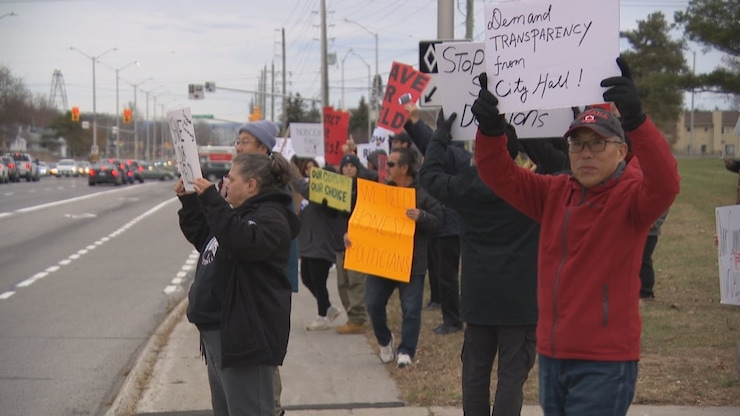
The proposal to build newcomer welcoming centres proved controversial, with several rallies held in recent months against the plan — including this protest near the Nepean Sportsplex last November. (David Bates/Radio-Canada) Photo: (David Bates/Radio-Canada)
‘They don’t know where to go’
Tawakalit Afolabi came to Canada as a refugee claimant in 2021 from Nigeria, originally landing in Manitoba and then quickly moving to Toronto and then Ottawa.
When I came to Ottawa… thank God for Google,
she said. Most of the time I was lost … there was a time I had no money, like I was practically begging people around me.
After years of navigating the system, she now works at a coffee shop and says she has encounters there with newcomers every day.
Those encounters, Afolabi said, have made it clear the resettlement services that would have been provided at the reception centres are crucial.
You will see immediately that they are lost. They don’t know where to go. They are searching for information,
Afolabi said.
Brown told CBC in an interview they are still moving ahead with the strategy to support newcomers but they’ve restrategized
in terms of making other sites available.
The city is instead looking at converting two more floors of the downtown YMCA (new window) and using an old federal building on Lanark Avenue.
According to Ebeltoft, the newcomer centre plan wasn’t the be all and end all solution
for supporting the influx of refugees.
It was really an opportunity to create and design a service delivery model where there is not one right now,
Ebeltoft said.
We’re not giving up. The city is not giving up. It may not be in the form of a sprung structure, but it’s going to be in the form of something,
Ebeltoft said.
This article is republished from RCI.