Canada News
ICC warns against sidelining Inuit as global powers eye Greenland

By Eilís Quinn, Eye on the Arcrtic, RCI
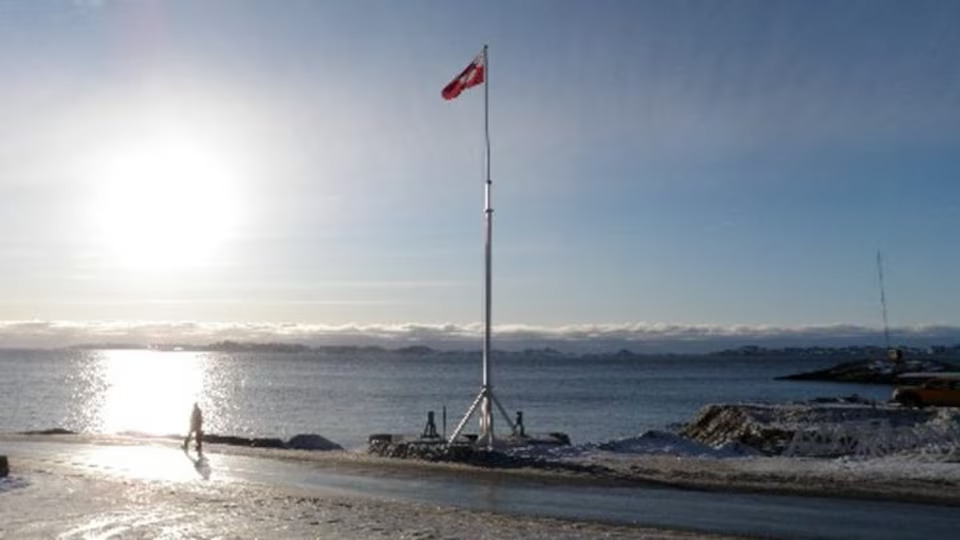
Greenland’s flag in Nuuk’s Old Town. “We do not wish to debate which state is better or worse to live in or is a better or worse colonizer,” ICC Chair Sara Olsvig said. “Rather we want to debate how we improve Inuit lives, livelihoods, wellbeing, and self-determination across all our regions.” Photo: Eilís Quinn/Eye in the Arctic
The Inuit Circumpolar Council (ICC) has issued a strong warning about the risk of marginalizing Indigenous voices as foreign powers increasingly eye Greenland for its strategic location and natural resources.
The growing attention on Greenland cannot be allowed to sideline the Inuit,
ICC Chair Sara Olsvig said in a statement.
Our rights and connection to the land must remain central in any discussions about its future.
The statement comes as Greenland’s strategic importance in the Arctic draws renewed focus from global powers, particularly U.S. President Donald Trump, who, in recent weeks has been increasingly vocal about his interest in the island’s geopolitical value and his hopes to buy it.
In December, Trump posted on Truth Social that control of Greenland was key for U.S. security.
In follow-up comments in January, Trump hinted at using economic pressure to influence the island and refused to rule out the possibility of military action.
Greenland’s strategic importance is further underscored by its hosting of the Pituffik Space Base, formerly known as Thule Air Base, the northernmost U.S. military installation, located 750 miles north of the Arctic Circle on the island’s northwestern coast.
In addition to its military significance, Greenland’s reserves of rare earth minerals and its location along Arctic trade routes also play a critical role in its geopolitical importance.
Greenland is a semi-autonomous territory within the Kingdom of Denmark, and seeks complete independence once its economy is able to replace the approximately $700 million US annual subsidy from Copenhagen.
Both Greenland’s government and the Government of Denmark, which is responsible for the island’s, defence, monetary policy and foreign affairs, have repeatedly said that the territory is not for sale.
Colonial history and geopolitical pressures
The ICC is an NGO representing the approximately 180,000 Inuit in Canada; Greenland; Chukotka, Russia; and in Alaska in the United States, with chapters in each of the four countries.
No one on at ICC-Greenland could be reached for comment on Tuesday. But in her statement, Olsvig, herself a Greenlander, took aim at foreign governments negotiating over Greenland and Inuit’s past experiences of marginalization.
We recognize and are acutely aware, that the current geopolitical situation is challenging, but times have changed since Inuit lands were mere commodities that could be bought and sold,
Olsvig said.
In today’s world, we are active participants in decision-making about our lands and resources. We are beyond the times of typical colonial attitudes of superiority.
ICC’s statement was made on Monday, the same day the Danish government, Greenland’s government and the Government of the Faroe Islands, also a part of the Kingdom of Denmark, announced (new window)$2.8 billion CDN for Part One of a comprehensive Arctic and North Atlantic defence agreement.
Most measures in the document were geared towards ensuring mobility and observation in and around Greenland including new Arctic ships, long-range drones and better satellite and sensor technology.
Part Two of the agreement is planned for later on this year.
This article is republished from RCI.