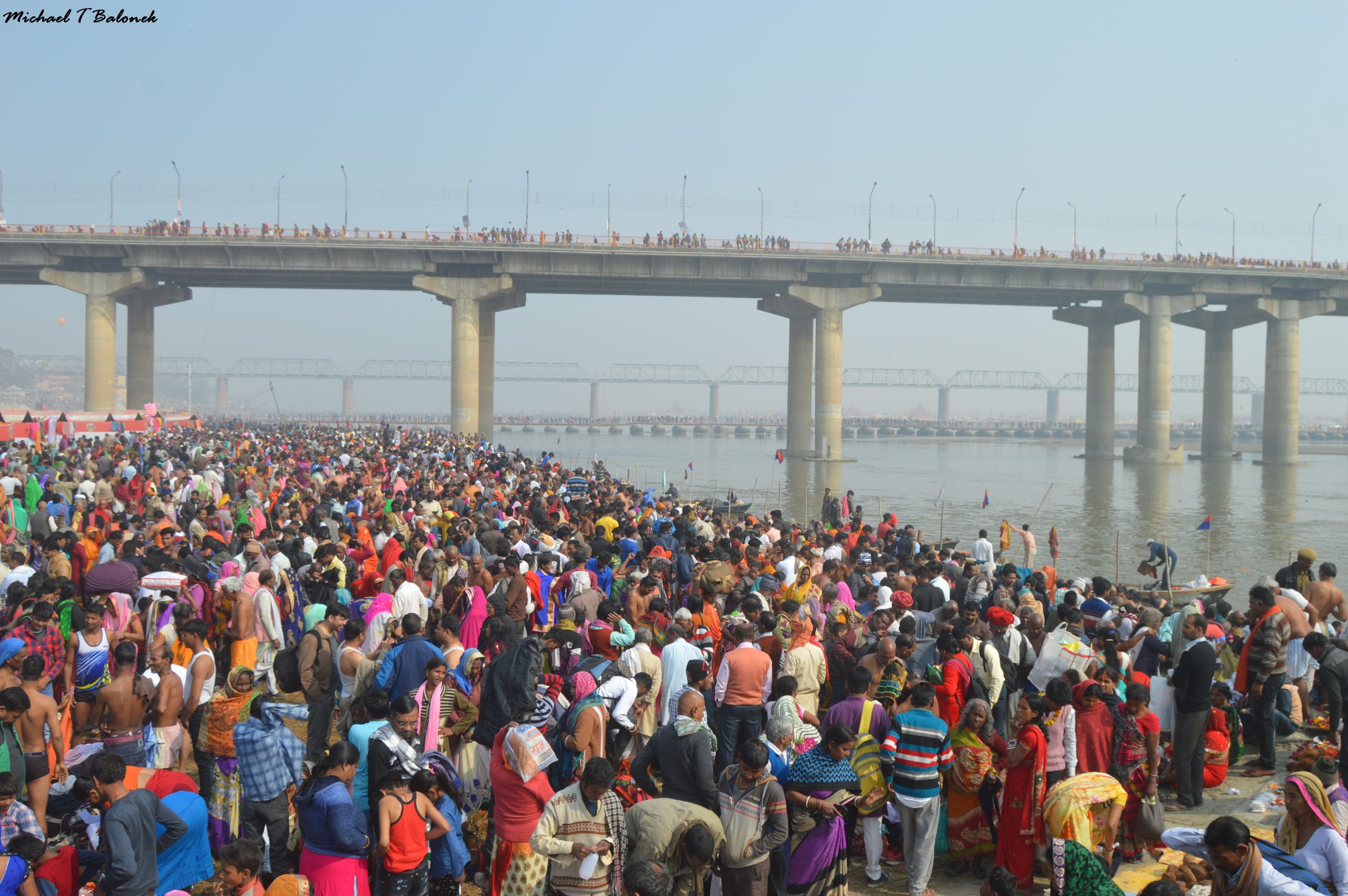
Imagine a gathering so large it dwarfs any concert, festival, or sporting event you’ve ever seen. In the Kumbh Mela, a religious festival held in India, millions of Hindu pilgrims come together to bathe in rivers considered sacred.
This year more than 400 million people are expected to attend the Kumbh Mela in the city of Prayagraj across 48 days.
How do you manage a crowd of this magnitude, in which the challenges are as colossal as the event itself?
The Kumbh Mela’s significance
The 2025 Kumbh Mela officially kicked off yesterday. Already, millions of people have taken a bath at the Triveni Sangam, the confluence of India’s most sacred river, the Ganges, with the Yamuna River and the Saraswati River.
The Kumbh Mela is one of the most important religious festivals in Hinduism and the largest human gathering on Earth. It is held periodically at one of four sacred locations – Prayagraj (formerly Allahabad), Haridwar, Nashik, and Ujjain – on a rotational basis, depending on specific astrological alignments.
There are four types of Kumbh Melas. The festival that’s currently on, the Maha (great) Kumbh Mela, takes place every 12 years at Prayagraj, in the state of Uttar Pradesh. It holds the highest significance due to its rarity, scale and profound spiritual importance.
The event draws millions of devotees, ascetics and spiritual leaders who come to bathe in sacred rivers, a ritual believed to cleanse sins and grant liberation from the cycle of life and death.
The festivals’ origins are rooted in Hindu mythology, and specifically in the story of the Samudra Manthan, or the churning of the ocean of milk. According to this legend, gods and demons churned the ocean in search of the nectar of immortality (amrita). During this struggle, drops of the nectar fell at the four sites where Kumbh Mela events are now held.
A great pilgrimage brings great risks
Mass gatherings, regardless of their purpose, carry inherent health and safety risks. The sheer scale of these events makes overcrowding and crowd crushes a constant threat, even without other risk factors.
However, religious gatherings add yet another dimension of risk. The heightened emotions and urgency associated with such events can escalate the potential for disaster.
India, with its tradition of large-scale religious festivals, has tragically become a hotspot for crowd-related catastrophes. Nearly 70% of India’s deadly crowd disasters have happened during religious mass gatherings.
This reality was underscored just last week, on January 8, when six people were killed in a crush near a temple in southern India. Similarly, last year’s Hathras crowd crush resulted in 121 deaths.
The Kumbh Mela hasn’t been immune either. Its history is marked by several tragedies.
The 1954 Kumbh Mela in Prayagraj remains one of the deadliest crowd disasters in history, with at least 400 people having been trampled to death or drowning in a single day. Some accounts suggest the actual death toll was much higher.
Subsequent festivals have also seen devastating incidents, such as:
- the 2003 Nashik Kumbh Mela stampede, in which 39 people died
- the 2010 Haridwar Kumbh Mela, in which seven people died
- the 2013 Prayagraj Kumbh Mela, in which 36 people died.
Reports of crowd disasters during the event date back as far as 1820, showing this challenge is far from new.
How has India prepared in 2025?
Indian authorities have implemented a range of measures to manage this year’s event in Prayagraj, using modern solutions and technology to tackle an age-old safety challenge.
A temporary tent city has been erected on the riverbanks in Prayagraj, with some 160,000 tents, 150,000 toilets and temporary hospitals.
Infrastructure upgrades include 98 “special trains” introduced to ensure smooth transport, along with centralised “war rooms” to monitor the operations.
On the ground, about 40,000 police officers have been deployed to maintain security.
Authorities have also installed 2,700 CCTV cameras across the grounds, all of which are integrated into an AI-powered surveillance system.
This setup enables the real-time monitoring of crowds, with AI used to analyse live feeds from thousands of fixed and drone cameras positioned across key festival zones, including entry points, bathing areas and congregation spaces.
Algorithms are used to measure the number of people in specific areas and provide information on crowd density. If density thresholds are exceeded, authorities are alerted and can respond on the ground, mitigating the risk of overcrowding and potential crushes.
For the first time, underwater drones are also being used to monitor the riverbeds of the Ganges and Yamuna.
Smaller gatherings remain a concern
The combination of massive, dense crowds, coupled with the deep devotion and excitement inherent in religious mass gathering, creates dynamics that are prone to safety risks.
These factors introduce a level of unpredictability to crowd behaviour, which can make said crowds difficult to manage.
While it’s reassuring Indian authorities have taken proactive measures to mitigate risks associated with the Kumbh Mela, risks persist in smaller religious gatherings across the country.
Smaller events, while they often lack media attention and resources, have proven just as prone to catastrophe as major ones.
The safety measures rolled out at this year’s Maha Kumbh Mela should serve as a blueprint for managing religious and cultural gatherings across India.
Milad Haghani, Senior Lecturer of Urban Risk & Resilience, UNSW Sydney
This article is republished from The Conversation under a Creative Commons license. Read the original article.