By Arthur Cosby, Mississippi State University and Viswadeep Lebakula, Oak Ridge National Laboratory; The Conversation
News
15% of global population lives within a few miles of a coast − and the number is growing rapidly


Coastal cities are often economic hubs, meaning job opportunities, access to trade and exposure to bustling communities. (Pexels Photo)
Coastal populations are expanding quickly around the world. The rise is evident in burgeoning waterfront cities and in the increasing damage from powerful storms and rising sea levels. Yet, reliable, detailed data on the scale of that population change has been hard to pin down, until now.
We study human geography as a sociologist at Mississippi State University and a computer scientist at Oak Ridge National Laboratory. Using newly available data from Oak Ridge that combines census results, satellite images and data science techniques, we were able to track growth patterns of coastal populations around the world.
The results show a striking pattern: The largest number of people by far – about 10% of the global population – live within 5 kilometers (3.1 miles) of the coast, and another 5% of the world’s people live between 5 and 10 kilometers (6.2 miles) from the coast. In the rings beyond 10 kilometers, the population declines swiftly.
That’s a lot of people
The United Nations estimates that Earth’s population passed 8 billion people in 2022, an increase of 1 billion in just over a decade.
We found that over 2 billion of those people – 29% of the total global population – lived within 50 kilometers (31 miles) of shore in 2018, based on Oak Ridge Laboratory’s publicly available dataset. About half of those inhabitants – over 1 billion people, or about 15% of the global population – lived within 10 kilometers of the water.
If you picture a globe, that means 15% of the world’s population was living on 4% of the Earth’s entire inhabitable landmass.
People are drawn to coastal areas for many reasons. Coastal cities are often economic hubs, meaning job opportunities, access to trade and exposure to bustling communities. These areas also offer access to nature, including fisheries and recreation.
We found that between 2000 and 2018, the global population living within 10 kilometers of the water increased by about 233 million inhabitants – about 28%. That’s equivalent to adding 23 new megacities with 10 million inhabitants each – about twice the size of the Miami metro area – right near the water’s edge.
Costly consequences
Human settlement patterns have profound consequences for people’s exposure to risk, particularly near the coasts.
Rising sea levels contribute to high-tide flooding, more extreme storm surge during hurricanes and erosion in regions around the world. In some areas, particularly Southeast Asia and the Pacific Islands, rising saltwater has infiltrated farm fields and freshwater sources. Hurricanes and typhoons, which gain strength over warm water, have intensified as temperatures have risen.
Coastal ecosystems, including fragile mangroves, wetlands and coral reefs, are also sensitive to the expanding coastal populations and to the infrastructure and pollution accompanying human settlement.
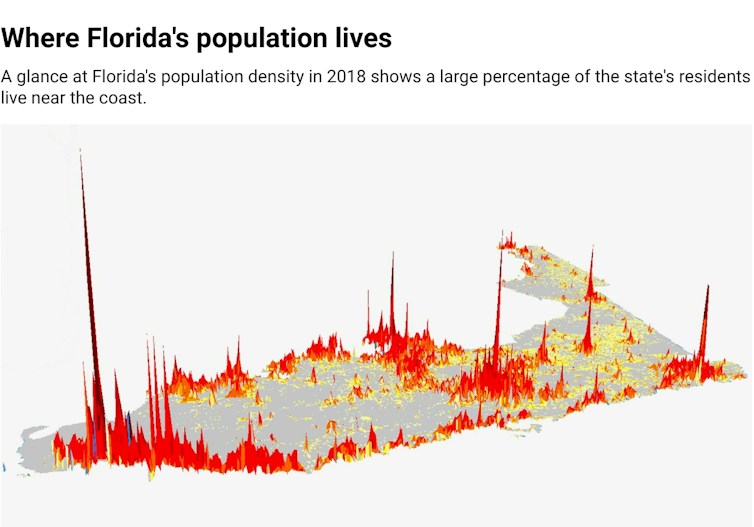
Despite the importance of understanding these population patterns in coastal regions, trying to get a global picture of the growth has been hazy at best. The LandScan Global project at Oak Ridge National Laboratory is changing that by starting to allow public access to annual high-resolution population data. We can used that data to estimate the magnitude and growth patterns of coastal populations on an annual basis.
Where coastal populations are booming
Coastal growth is happening across the globe, but we found the strongest growth patterns on two continents: Asia and Africa.
Currently, Asia has four of the five most populated countries: China, India, Indonesia and Pakistan. It also has 60% of the Earth’s coastal population. In comparison, Africa has about 12%, Europe has 11%, North America has 9% and South America has 7%.
But Africa has the fastest-growing population. Between 2000 and 2018, Africa’s coastal population grew 61%, with 58 million more people living within 10 kilometers of the oceans. Asia added 125 million more inhabitants within 10 kilometers of the coast – a more modest 25% increase.
Collectively, about 78% of the coastal growth was on those two continents.
On all of these continents, human population growth along the coast followed a similar pattern: The highest concentrations of inhabitants are in the bands closest to shore, decreasing rapidly as they move inland. Given the great differences among the cultures, economies and histories of the continents, it is remarkable to find consistent human population patterns.
Coastal regions are hubs of economic activity and infrastructure development, often playing critical roles in national and global economies. However, the rapid population growth is accelerating human and environmental risks.
Understanding these coastal population growth patterns is fundamental to addressing this global challenge.
Arthur Cosby, Professor of Sociology, Mississippi State University and Viswadeep Lebakula, Research Scientist in Human Geography, Oak Ridge National Laboratory
This article is republished from The Conversation under a Creative Commons license. Read the original article.

Continue Reading