Canada News
’We can’t just roll over’: Doug Ford doubles down on threat to shut down energy exports to the U.S.

By John Paul Tasker, CBC News, RCI
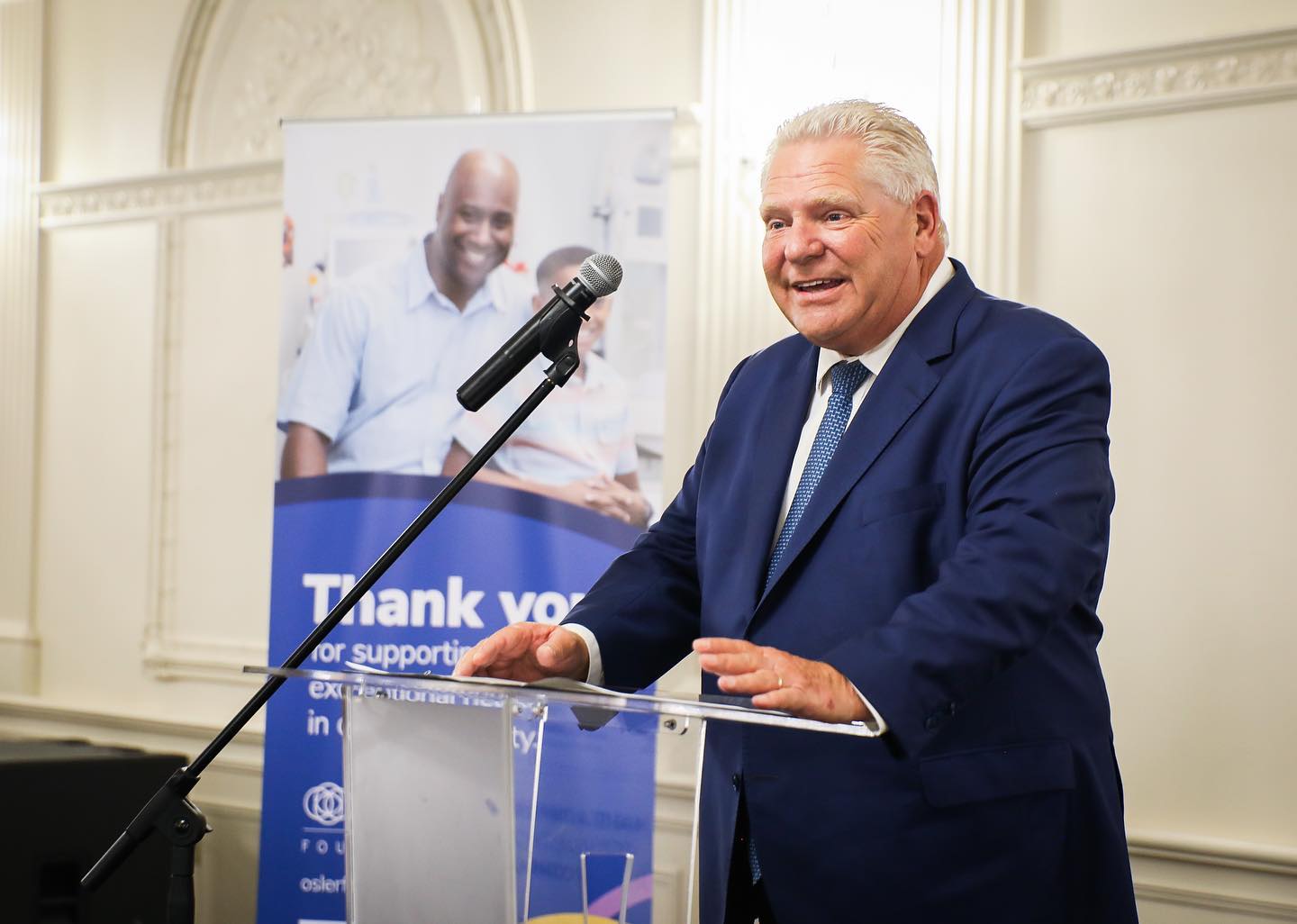
Ford said he doesn’t want to fight with the U.S. — in fact, he said he wants to do more business with the Americans. (File Photo: FordNation/Facebook)
‘We’re going to use every tool in our toolbox to defend Ontarians and Canadians,’ premier says
Ontario Premier Doug Ford said Thursday he’s dead serious about withholding energy exports to the U.S. if president-elect Donald Trump goes ahead with his plan to hit Canadian goods with steep tariffs that could cripple the economy.
Speaking to reporters at Queen’s Park, Ford said Ontario sends energy — mostly electricity — to power 1.5 million U.S. homes in states like Michigan, Minnesota and New York. He said he would cut off that supply if Trump follows through on his tariff threat.
We’re sending a message to the U.S. You come and attack Ontario, you attack the livelihoods of Ontario and Canadians, we’re going to use every tool in our toolbox to defend Ontarians and Canadians across the border,
Ford said.
Ford said he doesn’t want to fight with the U.S. — in fact, he said he wants to do more business with the Americans.
Cutting off electricity would be a last resort,
he said, but one he wouldn’t hesitate to deploy if Canada can’t broker a deal with Trump.
They’re not our enemy, they’re our allies,
Ford said of the Americans.
We can’t just roll over while we’re under attack.
WATCH | Ford says cutting off power to U.S. would be ‘last resort’
Ford says cutting off power to U.S. would be ‘last resort’ in tariff situation
Premier Doug Ford, who recently threatened to cut off U.S. access to power from Ontario if incoming president Donald Trump imposed tariffs, did not provide specifics on how that might work — but said the statement showed his government’s willingness to use every tool available to protect Canadian livelihoods.
A senior provincial official, speaking on background to CBC News, said the Ford government is considering other retaliatory measures as well.
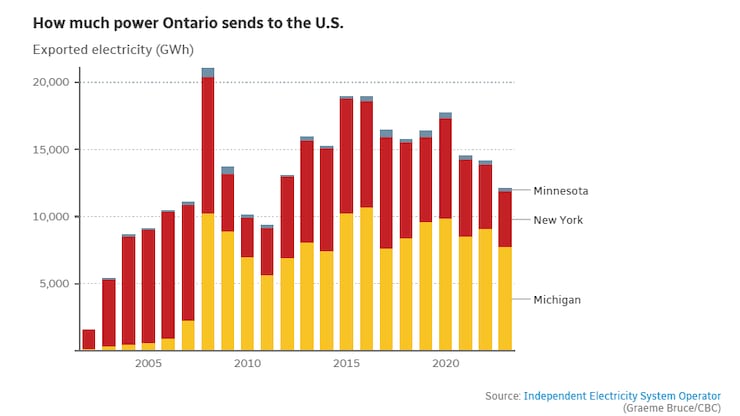
How much power Ontario sends to the U.S. Photo: Independent Electricity System Operator (Graeme Bruce/CBC)
The official said Ontario could curb exports of critical minerals, keep U.S.-based companies out of the provincial government’s procurement process and stop the LCBO, the largest purchaser of alcohol in the world, from buying American-made alcohol.
Data from Ontario’s Independent Electricity System Operator (IESO), the Crown corporation responsible for electricity exports to the U.S., reveals just how much is at stake for the states that depend on the province to power many of their homes and businesses.
Ontario exported 17,500 gigawatt hours of electricity in 2022 — 9,068 of it went to Michigan and 4,823 to New York, according to IESO. Another 275 gigawatts went to Minnesota. One gigawatt of electricity is enough to power 100 million LED light bulbs.
It will hurt them more than us, but we will be ready to respond with a plan to secure our jobs and protect Canadian industry. We have to build up an option list to maximize pressure on the U.S., should it get there.
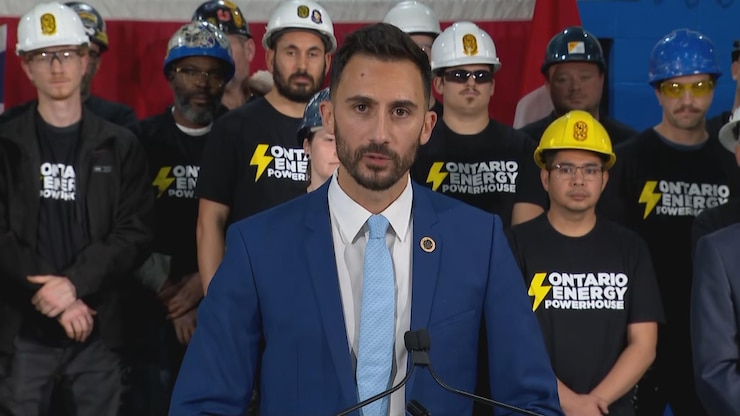
Ontario Energy Minister Stephen Lecce says the province is prepared to hold back “millions of dollars worth of valuable energy” from the U.S. if Trump goes ahead with his tariff threat. Photo: Radio-Canada
CBC News has asked the governors of Michigan, New York and Minnesota to comment on Ford’s threat but hasn’t heard back.
Ford said he will speak to Michigan Governor Gretchen Whitmer and New York Governor Kathy Hochul later Thursday. He said those conversations had been scheduled earlier and were not prompted by his threat to cut off energy exports.
Daniel Rosenbloom, a professor at Carleton University and an expert on Canadian climate policy and politics, said it’s possible for Ontario to dial back the amount of electricity it generates through natural gas and sends to the U.S.
From a technical feasibility standpoint, those plants can be shut down. It’s not like we have to take a nuclear reactor offline,
he told CBC News. That could be ramped down, as necessary.
While retaliation through energy exports is possible, Rosenbloom said he’s concerned about such trade actions creating chaos.
I’m worried about escalation. If we’re not attracting bees with the honey — if we go after the Americans with a stick — is this actually going to get the response we expect?
he said, adding Trump normally respects strong men
but also responds well to having his ego stroked.
Alexandra Mallett, a professor at Carleton and an expert on sustainable energy and climate policy, said Ford is pursing a tit for tat
approach with his energy threats.
It’s all about appearing strong to Trump. Ford’s trying to tell Trump, ‘I’m a tough person, you can’t mess with me. You can’t kick us around,’
she said. And that might be a good thing.
But she said she’s also worried about a ramped-up trade war spilling out of control. There’s just a lot of unpredictability to this situation,
she said.
While Ford threatens retaliation, Alberta Premier Danielle Smith is taking a different approach.
Speaking to reporters at an announcement about border protection, Smith said under no circumstances
will Alberta cut off its oil and gas exports to the U.S.
Canada exported four million barrels of crude oil a day last year — and 97 per cent of those barrels went to the U.S., according to federal data.
WATCH | Smith says she won’t cut off oil exports to U.S.
Smith says Alberta won’t cut off oil and gas exports to U.S.
Alberta Premier Danielle Smith says that under no circumstances will Alberta agree to cut off oil and gas exports to the United States. Smith was asked what she thinks of Ontario Premier Doug Ford’s threat to potentially cut off energy exports to the U.S. if president-elect Donald Trump moves ahead with heavy tariffs.
Those exports, the vast majority of which came from Alberta, were valued at $124 billion. A move to cut off those exports would be economically devastating for the province and the country as a whole.
I don’t support tariffs on Canadian goods and U.S. goods. All it does is make life more expensive. So instead, we’re taking a diplomatic approach. We’re meeting with our allies in the U.S. and making the case for Alberta oil and gas to be the solution to energy affordability, to energy security and to North American defence security as well,
Smith said.
But both Ford and Smith can agree on one thing: Prime Minister Justin Trudeau’s comment about Trump’s victory being a setback for women’s progress (new window) was unhelpful
at a tense time for bilateral relations.
Ford said he told Trudeau as much on the PM’s phone call with premiers last night. Donald Trump was elected democratically and if you like him or you don’t like him, that’s not our issue,
Ford said.
Smith also told Trudeau she didn’t like his comment. It’s not helpful,
she said Thursday. I think the American people voted pretty decisively for the Republicans and for president-elected Donald Trump, in particular.
WATCH | Trudeau implies Harris’s U.S. election loss is a step back for women’s rights
Trudeau implies Harris’s U.S. election loss is a step back for women’s rights
While speaking at the Equal Voice Foundation Gala in Ottawa on Tuesday, Prime Minister Justin Trudeau said ‘everywhere women’s rights and women’s progress is under attack, overtly and subtly.’
After Ford first floated his plan to cut off those exports, Finance Minister Chrystia Freeland said Wednesday that premiers across the country are drawing up plans to respond to Trump’s threatened tariffs.
They are identifying critical minerals and metals their provinces and territories export to the U.S. that could be the subject of trade action if Trump does deliver on his plan, Freeland said.
We would be derelict in our duties to Canada if we were not talking about, thinking about, working on how Canada would respond,
she said.
A spokesperson for federal Natural Resources Minister Jonathan Wilkinson said they had nothing else to say beyond what Freeland said Wednesday.
It’s not clear if Ontario could unilaterally curb electricity exports, or whether it would require Ottawa’s approval. Under the Constitution, provinces and territories are responsible for electricity systems within their borders.
Ford, who is also representing the country’s premiers as the current chair of the Council of the Federation, said he told Trudeau and Freeland last night that he would like to see the federal government launch an ad campaign in the U.S. to dissuade Trump from following through his promised tariffs.
Ontario already has launched a campaign of its own, with TV ads that will reach 100 million households in January, Ford said.
This article is republished from RCI.