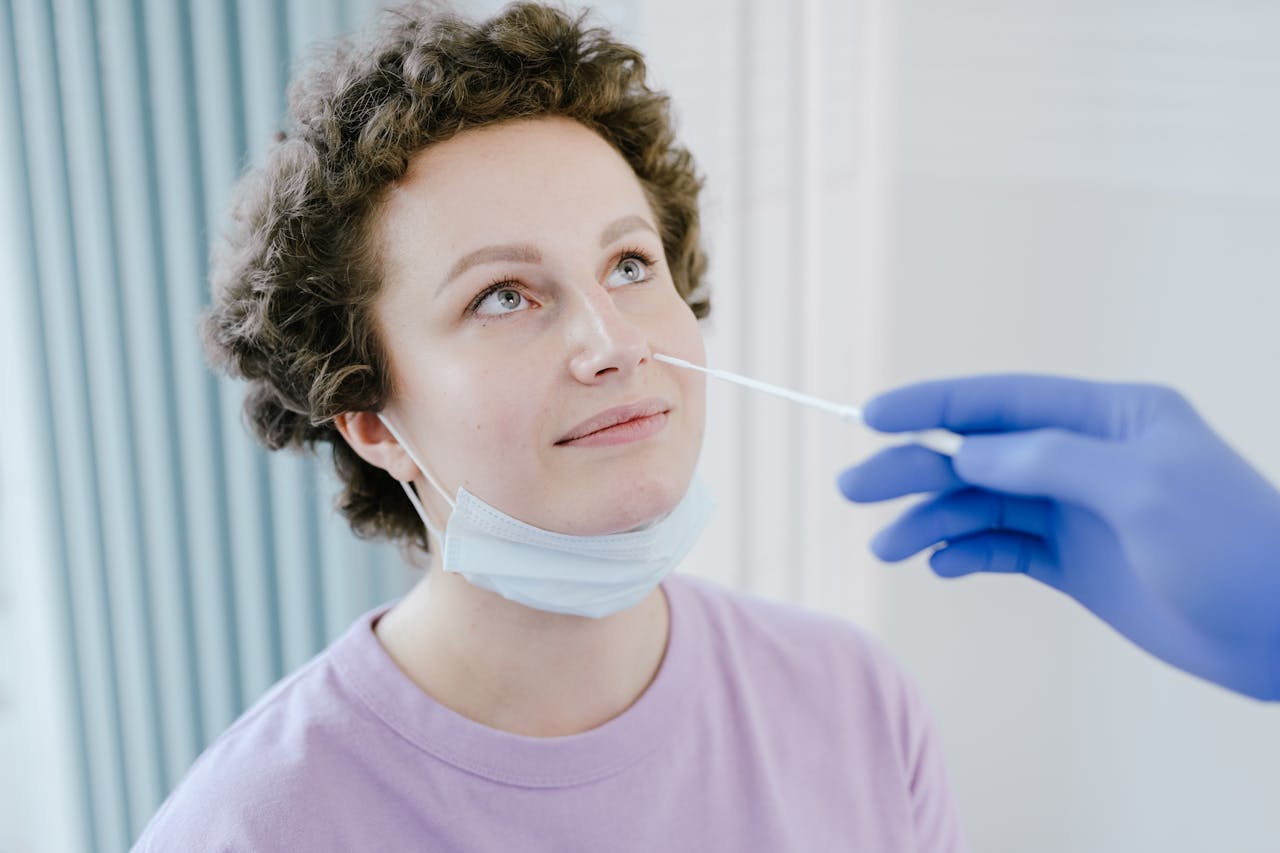
To our surprise, we found that, despite all the volunteers being carefully exposed to the exact same dose of the virus in the same manner, not everyone ended up testing positive for COVID. (Pexels Photo)
Throughout the pandemic, one of the key questions on everyone’s mind was why some people avoided getting COVID, while others caught the virus multiple times.
Through a collaboration between University College London, the Wellcome Sanger Institute and Imperial College London in the UK, we set out to answer this question using the world’s first controlled “challenge trial” for COVID – where volunteers were deliberately exposed to SARS-CoV-2, the virus that causes COVID, so that it could be studied in great detail.
Unvaccinated healthy volunteers with no prior history of COVID were exposed – via a nasal spray – to an extremely low dose of the original strain of SARS-CoV-2. The volunteers were then closely monitored in a quarantine unit, with regular tests and samples taken to study their response to the virus in a highly controlled and safe environment.
For our recent study, published in Nature, we collected samples from tissue located midway between the nose and the throat as well as blood samples from 16 volunteers. These samples were taken before the participants were exposed to the virus, to give us a baseline measurement, and afterwards at regular intervals.
The samples were then processed and analysed using single-cell sequencing technology, which allowed us to extract and sequence the genetic material of individual cells.
Using this cutting-edge technology, we could track the evolution of the disease in unprecedented detail, from pre-infection to recovery.
To our surprise, we found that, despite all the volunteers being carefully exposed to the exact same dose of the virus in the same manner, not everyone ended up testing positive for COVID.
In fact, we were able to divide the volunteers into three distinct infection groups (see illustration). Six out of the 16 volunteers developed typical mild COVID, testing positive for several days with cold-like symptoms. We referred to this group as the “sustained infection group”.
Out of the ten volunteers who did not develop a sustained infection, suggesting that they were able to fight off the virus early on, three went on to develop an “intermediate” infection with intermittent single positive viral tests and limited symptoms. We called them the “transient infection group”.
The final seven volunteers remained negative on testing and did not develop any symptoms.
This was the “abortive infection group”. This is the first confirmation of abortive infections, which were previously unproven. Despite differences in infection outcomes, participants in all groups shared some specific novel immune responses, including in those whose immune systems prevented the infection.
When we compared the timings of the cellular response between the three infection groups, we saw distinct patterns. For example, in the transiently infected volunteers where the virus was only briefly detected, we saw a strong and immediate accumulation of immune cells in the nose one day after infection.
This contrasted with the sustained infection group, where a more delayed response was seen, starting five days after infection and potentially enabling the virus to take hold in these volunteers.
In these people, we were able to identify cells stimulated by a key antiviral defence response in both the nose and the blood. This response, called the “interferon” response, is one of the ways our bodies signal to our immune system to help fight off viruses and other infections. We were surprised to find that this response was detected in the blood before it was detected in the nose, suggesting that the immune response spreads from the nose very quickly.
Protective gene
Lastly, we identified a specific gene called HLA-DQA2, which was expressed (activated to produce a protein) at a much higher level in the volunteers who did not go on to develop a sustained infection and could hence be used as a marker of protection. Therefore, we might be able to use this information and identify those who are probably going to be protected from severe COVID.
These findings help us fill in some gaps in our knowledge, painting a much more detailed picture regarding how our bodies react to a new virus, particularly in the first couple of days of an infection, which is crucial.
We can use this information to compare our data to other data we are currently generating, specifically where we are “challenging” volunteers to other viruses and more recent strains of COVID.
In contrast to our current study, these will mostly include volunteers who have been vaccinated or naturally infected – that is, people who already have immunity.
Our study has significant implications for future treatments and vaccine development. By comparing our data to volunteers who have never been exposed to the virus with those who already have immunity, we may be able to identify new ways of inducing protection, while also helping the development of more effective vaccines for future pandemics. In essence, our research is a step towards better preparedness for the next pandemic.
Marko Nikolic, Principal Research Fellow/Honorary consultant Respiratory Medicine, UCL and Kaylee Worlock, Postdoc Research Fellow, Molecular and Cellular Biology, UCL
This article is republished from The Conversation under a Creative Commons license. Read the original article.