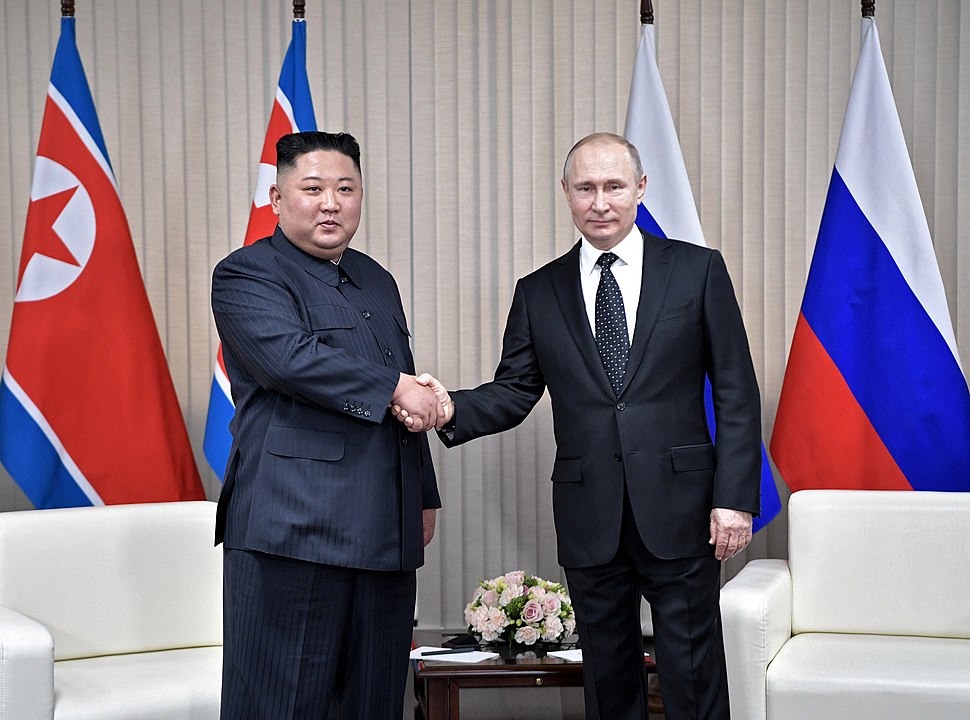
Putin and Kim denied at the time that they agreed an arms deal. (File photo by Kremlin.ru, CC BY 4.0)
The Russian president, Vladimir Putin, has spent two days in Pyongyang, meeting with the North Korean leader, Kim Jong-un, and signing a “comprehensive strategic partnership”.
Few details are being released about this deal and its expected ramifications for rearming Russian forces stretched by the Ukraine war. But the Kremlin said the agreement would mean each country would come to the aid of the other if attacked. At the top of the agenda for the meeting was almost certainly the war and Russian military requirements.
Since the Russian full-scale invasion of Ukraine in early 2022 Moscow has been ostracised by the west and its economy has been hit by a succession of harsh sanctions packages. North Korea’s leadership knows all about isolation and has faced decades of economic sanctions. Pyongyang is also increasingly seen as a threat to the security of the Asia-Pacific region – and potentially the United States, particularly in light of the regime’s longstanding pursuit of nuclear weapons capability.
But Putin is in Pyongyang looking for less sophisticated weapons than these. Despite both leaders denying they struck an arms deal when they met in 2023 in Vladivostok, North Korea has been accused of supplying Russia with the artillery and ammunition it so desperately needs to keep its war effort in Ukraine going. Putin and Kim denied at the time that they agreed an arms deal.
Meanwhile, Kim has been a supporter of Russia’s position over the Ukraine war, probably because closer ties with Russia offers the best solution to a range of problems North Korea faces. The North Korean leader has been eager to boost the prestige and security of his country since his overtures to then US president Donald Trump broke down in 2019, and this deal with Putin offers that platform.
Subsequently, the Biden administration has strengthened military ties with Seoul and South Korea and has adopted a tougher stance towards the North. At the same time, North Korea needs energy supplies for its ailing economy and food for its hungry people, so will be looking for economic support from Russia.
Nevertheless, this is neither the first nor the closest Russia-North Korea alliance. It is also not the first time weapons have been crucial to their relationship. The parallels to the alliance between Kim Il Sung – Kim Jong Un’s grandfather and the person the younger Kim has styled himself upon – and Joseph Stalin – the former leader of the Soviet Union who Putin seeks to emulate – are extremely clear.
Harks back to WWII
In the 1930s, Kim Il Sung was a relatively unknown Korean communist leading a small guerrilla band fighting the Japanese in Manchuria. During the second world war he fled to the Soviet Union and joined the Red Army, rising to the rank of major.
After the Japanese surrendered in August 1945, they handed what had been occupied Korea to the allies. It was split into two zones, one overseen by the Soviets, the other in the south overseen by the US.
Kim Il Sung was handpicked by Stalin to lead the Korean Workers party and then to lead North Korea when it was formally established in 1948. Kim’s loyalties to the Soviet Union were clear and he was determined to create a Stalinist state.
He was principally a Korean nationalist and was determined to unite the Korean peninsula under his rule. But he could not launch an invasion into South Korea without Stalin’s permission and, crucially, Soviet weaponry.
Kim Il Sung made numerous requests to Stalin for this support. Yet, Stalin remained cautious in the early cold war, fearing the United States would retaliate if its South Korean ally was attacked.
The situation then rapidly changed. In October 1949 the Chinese Communist party defeated its Nationalist rivals for power and the People’s Republic of China was born. Also, in January 1950 the United States suggested it would not come to the defence of South Korea if attacked.
After this, Stalin became more amenable to Kim’s pleas, believing the North Korean leader’s claims that victory would be swift. He then wrote to Kim Il Sung giving him the green light and supplying him with the weapons he desired. Much of this military hardware was old second world war stock but it included 200 T-34 tanks that had proven highly effective against Nazi Germany.
With this decision, the Soviet-North Korean alliance was cemented. However, it immediately led to the gravest crisis of the early cold war. The North Korean invasion on 25 June 1950 – almost exactly 74 years ago – did not lead to a quick victory, since Washington refused to abandon its ally and intervened along with 15 other countries under the United Nations’ aegis.
When North Korea appeared defeated, Beijing entered the fray and the world came perilously close to an atomic third world war. Yet, much like the war in Ukraine, it soon became a stalemate. The Korean war then dragged on for two more years before the armistice that is still in operation today was signed.
Hopefully nothing as devastating or risky as the Korean war will result from this new alliance between Russia and North Korea. But it is important to understand that this relationship has a long history. Its roots are in an earlier bloody conflict from a time when the leaders in Moscow and Pyongyang felt isolated and were willing to take dangerous measures to change this situation.
Robert Barnes, Senior Lecturer in History, York St John University
This article is republished from The Conversation under a Creative Commons license. Read the original article.