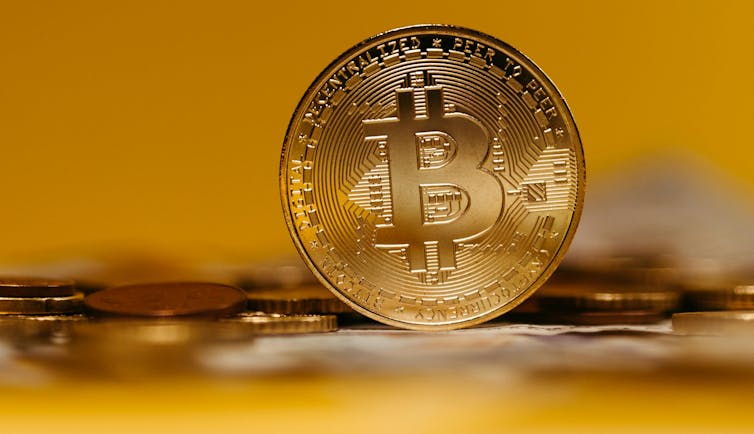
The Australian Securities Exchange (ASX) has just seen the listing of its first bitcoin spot exchange-traded fund – “ETF” for short.
Issued by investment management firm VanEck, the new investment product is trading under the ticker symbol “VBTC”.
It’s not the first bitcoin ETF to launch in Australia, others have been available for some time on the smaller exchange Cboe Australia. But it is a first for the ASX, our largest stock exchange.
If international experience is anything to go by, the ASX’s new bitcoin spot ETF is likely to draw significant interest and could be the first of many similar products. In January, American investment manager BlackRock launched a similar product in the US – “IBIT” – which has since grown to manage almost A$30 billion in assets.
As Australia braces for a possible flood of new mainstream cryptocurrency investment products, it is important to know more about how they work and what risks they might entail.
A basket of investments
ETFs are investment products that track the performance of an underlying asset. Like shares, they can be traded on a public stock exchange. But buying an ETF is like buying a basket of different investments, the contents of which can vary.
Bitcoin or gold ETFs, for example, track the price of just one commodity. But equity ETFs can track whole collections of stocks, combined in proportions that reflect a particular index.
It is important to understand the difference between “spot” ETFs which actually hold their underlying investments, and “futures” ETFs which invest in derivative securities to approximate the performance of their nominal investments.
For example, BlackRock’s IBIT product is a spot ETF, because it invests in bitcoin directly. A different ETF – ProShares “BITO” – is a futures ETF, because it invests in bitcoin futures (contracts to buy or sell bitcoin at a future date) in a way that tracks the price of the underlying asset.
Bitcoin ETFs are gaining momentum because they allow traditional investors to access a popular asset class that is still largely unregulated. Unlike buying cryptocurrency directly, the transaction is mediated by a large ETF issuer and takes place through a regulated stock exchange.
But they also create new costs, including management fees that can significantly impact returns.
Nowhere near the size of the US market
In the US, the watershed moment for spot bitcoin ETFs came on January 10 this year, when the US Securities and Exchange Commission approved 11 of them.
These funds have since accumulated more than A$75 billion in combined assets under management, and BlackRock’s IBIT – the most liquid (easiest to buy and sell) – regularly sees more than A$1 billion in trades in a day.
In comparison, existing Australian bitcoin ETFs are orders of magnitude smaller in scale. Global X’s “EBTC”, which has traded on Cboe Australia since 2022, manages just over A$100 million in assets and sees a mere fraction of the trade volume.
This means liquidity – the ease with which an asset can be bought, sold and converted to cash – is much higher in the US.
The contrast between the US and Australia on this front is driven in large part by the different degree of involvement by institutional investors. Ease of trade means big asset management funds around the world are more likely to trade in the US, further fuelling total assets under management over there.
This institutional involvement in bitcoin markets has become substantial. Some 12.5% of the currency’s 21 million coin supply cap is now held by just 90 institutional entities, including countries, publicly traded companies and ETFs.
Management fees matter
For huge institutional investors trading millions or billions of dollars at a time, liquidity is typically the main cost consideration when trading ETFs. Low liquidity can make it harder to buy and sell at a favourable price. But for smaller retail investors it’s management fees.
A management fee of 1% per year means that if an investment grows from $100 to $105 over the course of the year, an investor will only end up with $104 in their account. $1 goes to the ETF issuer.
It might not seem like a lot, but for a buy-and-hold investor, small differences in management fees can matter a lot.
For example, over ten years, a hypothetical starting investment of $10,000 with a constant annual return of 5% would earn $1,178 less by investing in an ETF with a 1% management fee compared to one with a 0.2% management fee.
Today’s ASX listing has already ignited a management fees “price war” between VanEck and rival bitcoin ETF provider Global X.
Global X will reduce their ETF’s management fee to 0.59% from July, to match VanEck’s new offering. But in the US, many bitcoin ETFs have lower fees, some in the range of 0.2%-0.25%.
Retail investors will be the key factor
The Australian market for bitcoin ETFs is smaller and – for now – significantly less competitive than its US counterpart.
Depending on the success of new launches like today’s, market dynamics will reveal whether the Australian market will eventually see lower fees, more liquidity, and other ETF issuers joining the Australian offerings.
That could end up hinging on the uptake of these ETFs by retail investors, as major institutions continue to face fewer hurdles in the US.
Marta Khomyn, Lecturer, University of Adelaide
This article is republished from The Conversation under a Creative Commons license. Read the original article.