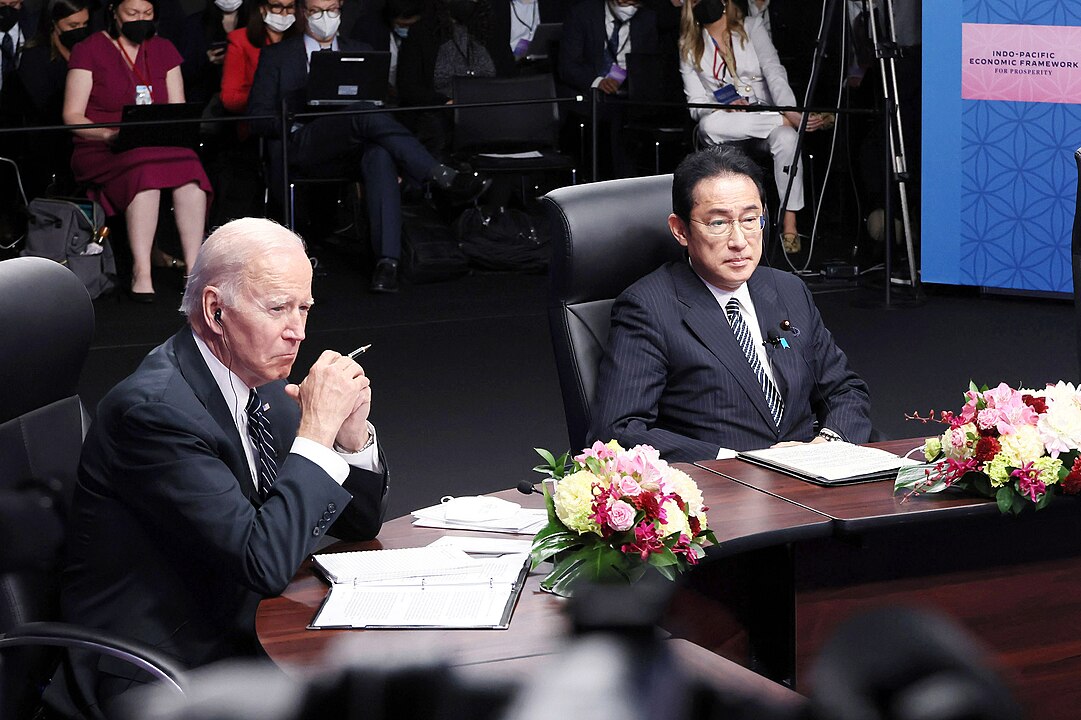
FILE: President Joe Biden and Japanese Prime Minister Fumio Kishida. (Photo By 首相官邸/Wikimedia Commons, CC BY 4.0)
April 2024 proved to be a busy month in Japanese-U.S. diplomacy.
The month saw a state visit to the U.S. by Prime Minister Fumio Kishida that included a White House sit-down with President Joe Biden on April 10. The next day, both men were joined by Philippine President Ferdinand Marcos Jr. for the first-ever U.S.-Japan-Philippines trilateral summit.
Then on April 23, a former prime minister and leading figure in Japan’s ruling Liberal Democratic Party, Taro Aso, met with Donald Trump in New York.
As an expert on U.S.-East Asian foreign relations, I believe the flurry of diplomatic activity points at two things: a keen desire on Japan’s part to ramp up engagement with Washington as part of an Indo-Pacific strategy, and very real concerns in Tokyo that the U.S. might not be so committed – regardless of who’s leading the country after this year’s election.
Allies and co-stewards
The Japanese government under Kishida – who was elected prime minister in 2021 – has made clear it is all in on the alliance with the U.S.
Kishida hopes to assert Japan’s role as not just the U.S.’s strongest ally in East Asia, but also as co-steward of the “liberal international order” – that is, the global rules and agreements set up after World War II by leading economies.
Kishida’s intentions were made clear in Japan’s 2022 National Security Strategy, which detailed Japan’s short- and medium-term strategic goals. While it included a commitment to unprecedented defense spending and the development of new defense capabilities, it did so in the context of an emphasis on the country’s relationship with the U.S. as “the cornerstone of Japan’s national security policy.”
Japan’s strategy also calls for the bilateral relationship with the U.S. to go beyond traditional security concerns, extending to the provision of economic security through efforts to bolster the resilience of global supply chains and enhance economic engagement between allies.
Investing in alliances
In large part, Japan’s desire to strengthen its partnership with the U.S. has been reciprocated by Washington.
Closer ties are in keeping with the Biden administration’s plan to invest in alliances as a core feature of its foreign policy. The Biden White House has been particularly focused on greater security cooperation across the Indo-Pacific region.
To that end, Biden and Kishida showcased a U.S.-Japan joint command center and a new Japan-U.S.-Australia air missile defense network during their April meeting. Similarly, the trilateral meeting with the Philippines saw the unveiling of enhanced U.S. Coast Guard training for its Asian partners, and joint patrols in the South China Sea.
While the implicit, if not explicit, target of such collaborative efforts is often the perceived threat of China to regional stability, the strategy has wider geopolitical implications.
In forging alliances between like-minded countries, the U.S. and Japan are promoting a global system based on the existing liberal international order, but which emphasizes the different visions held by democracies and nondemocracies. In other words, they are attempting to create security through distinction – or an “us versus them” strategy – rather than universalism.
It is toward this goal that the U.S. has actively encouraged better relations between Japan and South Korea – two democratic U.S. allies that have been deeply divided over how to reconcile after Japan’s colonization of the Korean Peninsula in the early 20th century.
What a Trump win might mean to Tokyo
Yet despite the U.S. and Japan being in lockstep on many issues affecting the Indo-Pacific region, the recent diplomatic blitz in Washington – as well as the lead-up to the visits – also sheds light on areas of difference and of concern for Japan.
While Kishida has emphasized the U.S.-Japan economic relationship as a win-win scenario, the Biden administration has been keener to focus on security measures.
Indeed, on trade and economic issues, Washington isn’t quite on the same page as its Asian partners.
For example, Biden has come out against the proposed purchase of U.S. Steel by Japan’s Nippon Steel. Biden’s reticence echoes a prevailing belief in economic nationalism in Washington, steeped in domestic politics.
But Tokyo’s concerns go beyond the hesitancy of the current U.S. administration in regard to Japanese investment.
A potential second Trump presidency may, it is feared in Tokyo, upend the work that the Biden administration has done to reinvigorate the alliance system in the Indo-Pacific.
It could also see the U.S. retreat further into economic nationalism. Under Trump, the U.S. saw tariffs as a major foreign policy tool,
while portraying alliances as transactional. For example, Trump demanded that Japan quadruple the annual payments it made for U.S. troops to be stationed there.
Also under the Trump administration, and to Japan’s chagrin, the U.S. left the Trans-Pacific Partnership multilateral trade deal, which continued without the U.S. in the form of the Comprehensive and Progressive Agreement for Trans-Pacific Partnership.
Japan on PR offensive
Japan is beginning to hedge against a Biden loss in November and lay the foundations for what many in Tokyo hope will be a positive relationship with Trump, should he become president again.
Former Japanese Prime Minister Shinzo Abe, who was assassinated in 2022, forged such a relationship with Trump. And it was notable that it was Abe’s former deputy prime minister, Aso, who met with Trump in New York to reestablish a personal connection now – although Kishida’s government described Aso’s visit as that of an individual lawmaker acting in his own capacity.
Still, Kishida knows that it is not just a Trump presidency that could threaten Japan’s interests and goals for the Pacific region. American political elites in general are trending more toward isolationism. Meanwhile, the American public is increasingly divided and unsure about the benefits of trade and the role that the U.S. should be playing globally.
In his U.S. visit, Kishida sought to speak not only to the Biden administration, but to Congress – both Democrats and Republicans – as well as the U.S. business community and the American public.
It was not only a leadership summit, but a public relations tour.
During his remarks to Congress – only the second by a Japanese prime minister – Kishida stressed the need for the U.S. to be a reliable ally, saying “the world needs the United States” and “the people of Japan are with you, side by side, to assure the survival of liberty.”
And he reiterated the ties between the two countries – while highlighting the positive economic contribution Japan is making in the U.S. – in a subsequent visit to North Carolina, where he toured a Toyota electric vehicle battery factory and a HondaJet subsidiary.
Looking for a stable relationship
Japan is embracing its identity as an actively contributing member of the liberal international order. With the U.S. exit from the Trans-Pacific Partnership and uncertainties over Washington’s global role during the Trump administration, Japan stepped up as a leading proponent of maintaining and perpetuating that order.
But Japan is looking for the U.S. to continue to play a central role, too.
The high-profile meetings between Japan’s political elite and both Biden and Trump indicate that Tokyo is looking for the U.S. to be a reliable partner – both for the sake of regional security and for economic prosperity. But this is something that U.S. domestic politics is making it more difficult to achieve.
Mary M. McCarthy, Professor of Political Science, Drake University
This article is republished from The Conversation under a Creative Commons license. Read the original article.