News
North Korea has demolished its monument to reunification but it can’t fully erase the dream

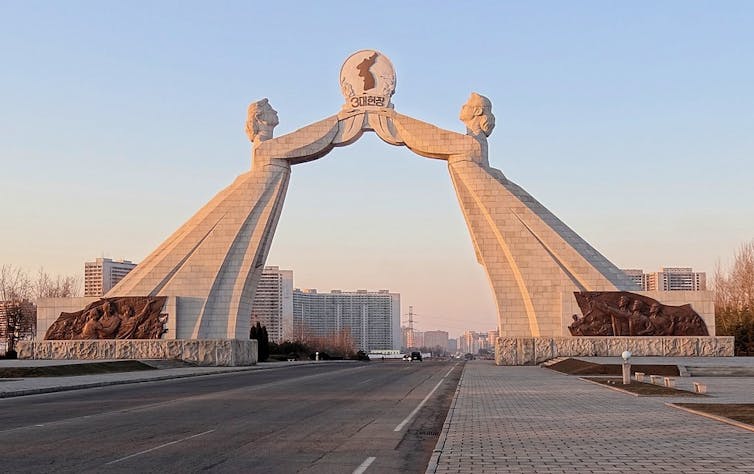
North Korea has demolished the Arch of Reunification, a monument that symbolised hope for reconciliation with the South. The decision to demolish the monument came shortly after the regime’s leader, Kim Jong-un, delivered a speech declaring it an “eyesore”.
In the same speech, Kim said that the peaceful reunification of the two Koreas, which have remained divided since August 1945, was no longer possible and called for an amendment to the North Korean constitution to reflect South Korea’s status as his country’s “principal enemy”.
Unveiled in 2001, the Arch of Reunification featured two Korean women wearing traditional dresses – called hanbok (한복 “Korean clothes”) in South Korea and chosŏn-ot (조선옷 “Korean clothes”) in the North. The women jointly held up an image of the unified Korean peninsula, reflecting the North Korean government’s genuine desire at the time to reunify the two countries.
This is not the first time North Korea has destroyed symbols of Korean cooperation, dialogue and hope for unification. In June 2020, North Korea recorded and released footage of it blowing up a joint liaison office with South Korea near the border town of Kaesong. The site was opened to help the the two countries communicate.
The following year, in August 2021, North Korea severed the Inter-Korean hotline – a series of over 40 telephone lines that connect North and South Korea – in protest against military drills jointly undertaken by South Korea and the US. Kim did, however, restore the hotlines two months later and urged Seoul to step up efforts to improve relations.
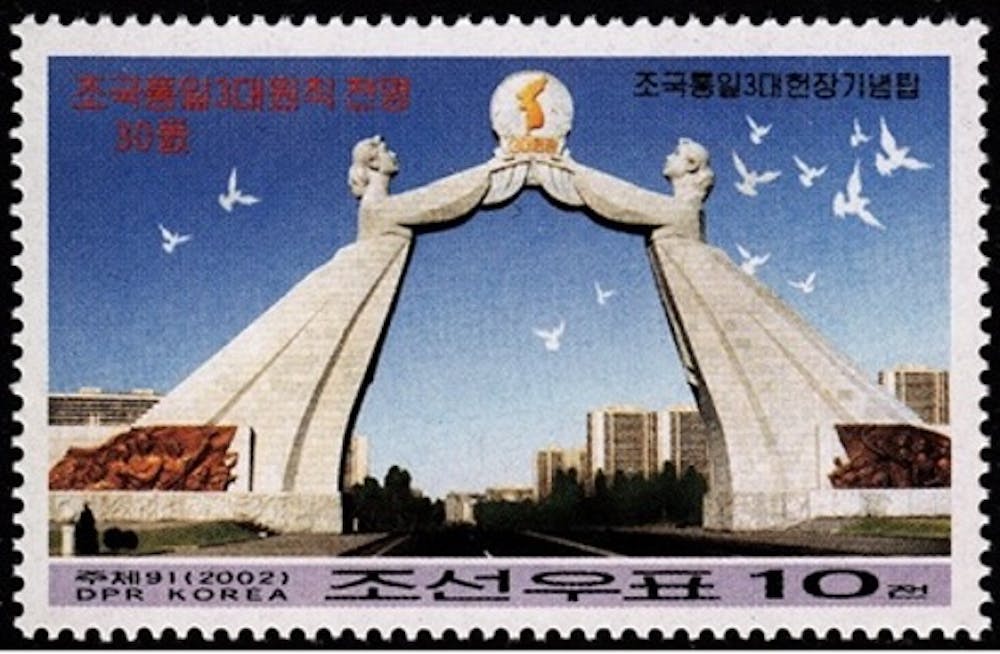
The Arch of Reunification’s demolition signals North Korea’s determination to brand reunification as impossible. But, despite the physical erasure of this monument, its depiction on five official postage stamps serves to immortalise the monument and what it symbolised.
David Hall, CC BY-NC-SA
Propaganda postage stamps
Postage stamps function not only as items that display the paying of postage rates, but also as small carriers of propaganda messages. They have, in the past, been described as “ambassadors” conveying official viewpoints, and “windows of the state” that illustrate how it wishes to be seen by its own citizens and those beyond its boundaries.
In most authoritarian states, revisions to official party narratives require the alteration and removal of symbols associated with the previous narrative. The most notable example of this is the removal of former Soviet leader Joseph Stalin’s name from many cities and landmarks following his death in 1953.
This formed part of the de-Stalinisation movement in the late 1950s and dismantled Stalin’s “cult of personality”. Stalin had used art and popular culture to improve his status as leader and inspire loyalty.
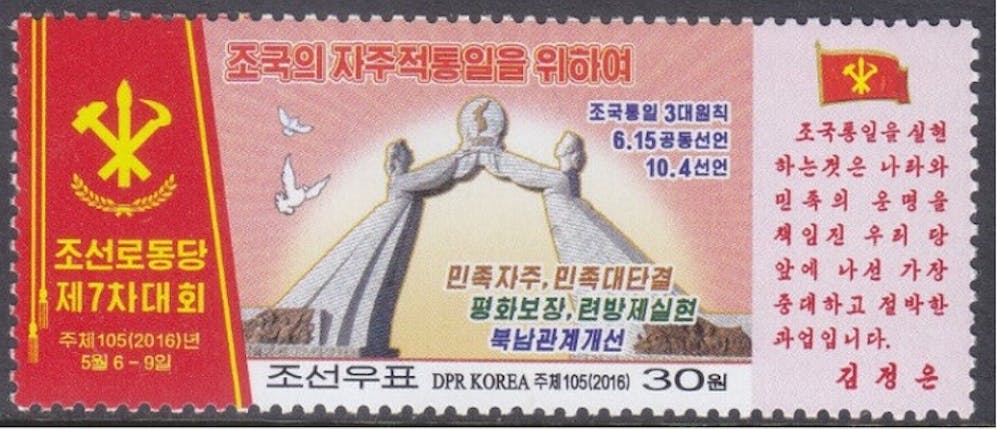
In a similar way, the official North Korean postage stamp catalogue removed five stamps from its listings that depicted the Arch of Reunification. Stamp catalogues provide information relating to when stamps were issued, who designed them, their dimensions and colour. Having this information is important when collecting and analysing them.
David Hall, CC BY-NC-SA
It’s not certain exactly when the stamps were removed. But Wayback Machine (a digital archive of the World Wide Web) indicates there was a change to the website on January 19, placing the change squarely within the timeframe of Kim’s speech and the reported demolition of the monument. All visual and textual references to the stamps have been removed from the website.
NK News also reported around this time that North Korea was purging propaganda websites of old content, suggesting a rewriting of the official narrative.
There is precedent for this. North Korea has previously removed listings from its official stamp catalogues after they have been issued because they run contrary to new state narratives.
In 1960, for example, North Korea released a set of five stamps celebrating the reconstruction of Pyongyang after the Korean War (1950–1953). Two of the place names shown on the stamps, “Mao Zedong Square” and “Stalin Street”, were later renamed “Triumph Arc Square” and “Victory Street”. However, as the stamps issued in 1960 contained the original names, their visual depictions in subsequently published stamp catalogues were not included.
The reunification dream lives on
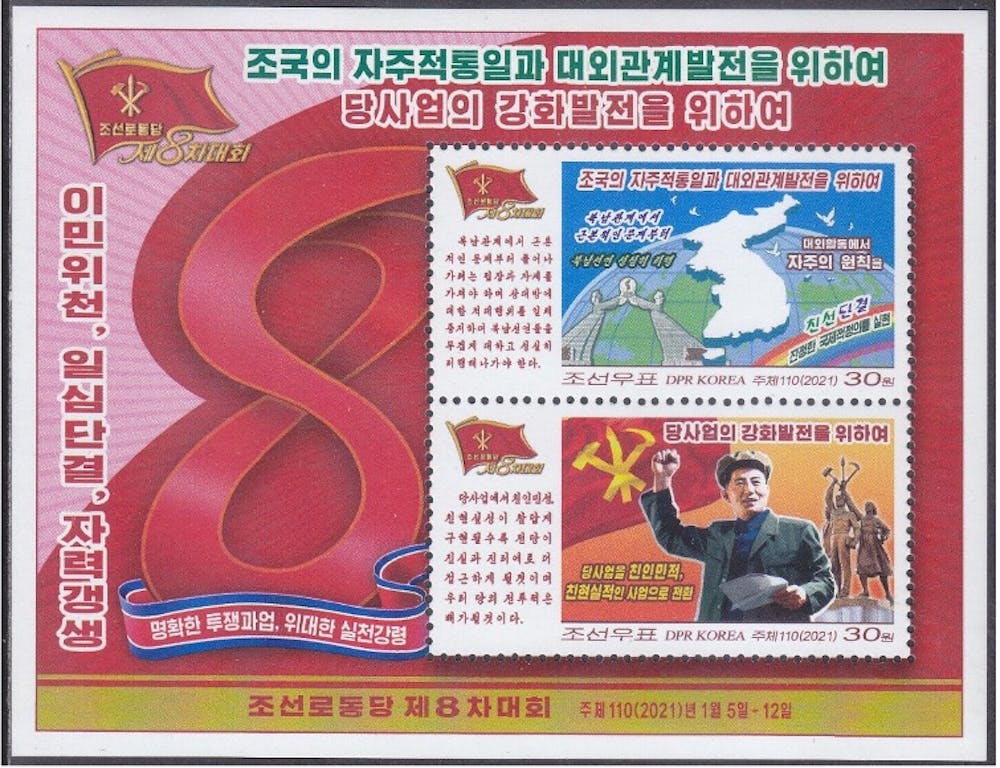
The Arch of Reunification was first depicted on a North Korean postage stamp in May 2002, almost one year after its unveiling. But the monument has been depicted more recently, on two stamps issued in 2015, and two more stamps issued in 2016 and 2021 respectively.
North Korea is seeking to erase any remnant of the Arch of Reunification’s depiction. But, unfortunately for North Korea, these stamps exist in the private collections of foreign stamp collectors.
David Hall, CC BY-NC-SA
The stamps were released to the world through Korea Stamp Corporation (North Korea’s state-run postal authority) offices in Russia and China at the time of issue. These stamps can still easily be bought from stamp dealers on online platforms such as eBay.
For that reason, North Korea can never fully erase these depictions of the unification dream as it doesn’t have full control over how its state narrative is presented and potentially altered.
David Hall, PhD Candidate in Korean Studies, University of Central Lancashire
This article is republished from The Conversation under a Creative Commons license. Read the original article.