
Fashion and Beauty
What you need to know about rebranded skin-whitening creams


Products are also marketed to white women with the promise of making white women’s aging skin and faces appear smooth, wrinkle-free and younger looking. As an anti-aging care, skin whitening is formulated to bleach out visible signs of aging such as age spots. (Pexels photo)
Corporations like Unilever, L’Oréal and Johnson & Johnson recently announced they will no longer sell products that mention “skin whitening.”
These companies will now adjust how they market their products, especially on social media. However, they will continue to promote creams and serums formulated for skin-whitening effects. These companies have already developed other terms besides “skin whitening” to promote their products.
The multi-billion-dollar market for skin whitening products is an enduring sign of commodity racism. Skin whitening is at once an old and emerging globalizing industry. Women (and some men) whiten their skin by using products that reduce or suppress melanin biosynthesis and function.
Products are also marketed to white women with the promise of making white women’s aging skin and faces appear smooth, wrinkle-free and younger looking. As an anti-aging care, skin whitening is formulated to bleach out visible signs of aging such as age spots.
So actually, skin-whitening products have already been marketed under different labels such as skin brighteners for at least the past 20 years.
Transformation from whiteness to wellness
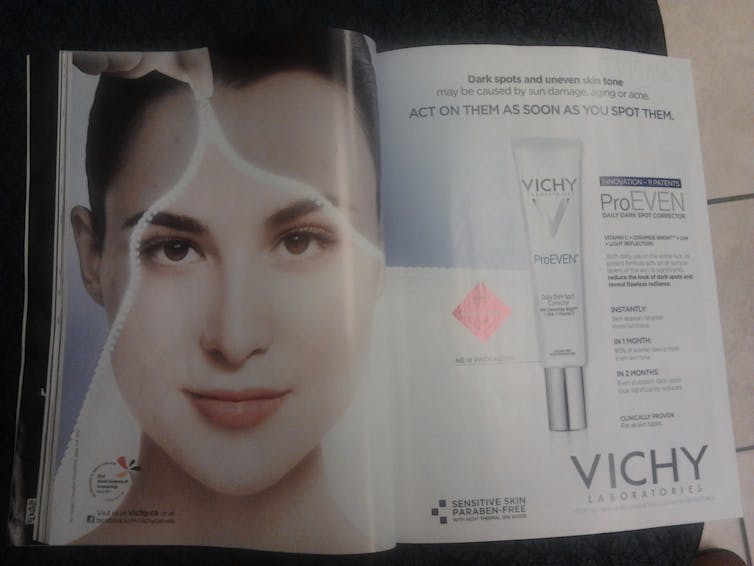
Medical sounding terms such as cosmeceutical and skinceutical have long been used to market skin-whitening products to white women to fight age spots, dull skin, hyperpigmentation, etc. These coded words widely promote the message that good skin is youthful looking and glowing.
In the marketing of skin-whitening products, lighter skin embodies whiteness not only as a sign of racial difference but also as a signifier of class privilege. The rebranding and niche marketing of skin-whitening products is made easier by the fact that these are often melanin-suppressing products with pharmaceutical properties.
(Amina Mire), Author provided
Increasingly, advertising for skin-whitening cosmetics uses terms that can be substituted with whiteness: glowing, radiant, translucent, bright and clear. These terms frame skin whitening as a source of recuperative wellness and youthful femininity.
Meanwhile, there is no clearly defined regulatory framework for these products. This makes it easier for endless rebranding and niche marketing of skin whitening products.
The banner of anti-aging
Skin whitening has been marketed as part of a fight against aging, which means it has also come to be seen as a legitimate way to take care of one’s skin. Women are told over and over that getting and keeping glowing skin at all ages is a standard requirement for femininity and beauty.
When corporations promote skin whitening under the banner of anti-aging wellness to aging middle class white women, the practice is often defended, both by consumers and the cosmetics industry, as a legitimate way of regenerating the aging white female body and shielding it from environmental deterioration, modern stress, air pollution and more. In this way, advertisements for anti-aging skin whiteners are supposedly formulated to promote wellness by restoring, regenerating and protecting white women’s skin from the harmful effects of sun damage and other environmentally induced signs of aging.
Read more:
Indian men are swapping ‘tall, dark and handsome’ for ‘tall, fair and debonair’
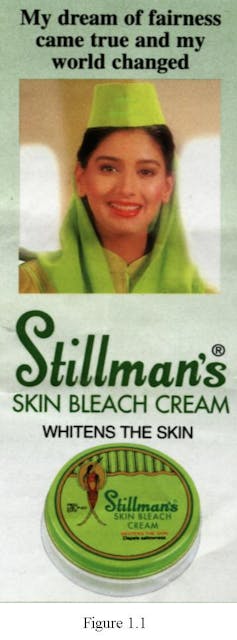
The idea that increased pigmentation represents an unhealthy process of premature aging has facilitated the promotion of skin whitening products to both white women and women of colour. The symbolic association of whiteness with youthful appearance and anti-aging wellness has driven the research and development and mass marketing of high technology-based skin whitening products with anti-aging claims.
As a result, the industry invites all women, regardless of ethnicity, race and or nationality, to seek smooth, radiant and youthful-looking skin, which is free from age spots and hyperpigmentation, by consuming skin-whitening products.
(Amina Mire), Author provided
The misguided desire for whiteness
In the past two decades, skin-whitening products have been promoted in glossy magazines, online shops, upscale health spas, wellness boutiques, department stores and websites run by cosmetics firms. It is pertinent to stress that the globalization of skin whitening depends on more than a misguided desire for whiteness.
The cosmetics, pharmaceutical and biotechnology industries will continue to invest in skin-whitening products by using terms which convey that a good skin is youthful looking — and white.
The leading cosmetics and pharmaceutical firms have declared that they will no longer mention skin whitening. Yet they will continue to promote products that produce skin-whitening effects. This lack of real change reveals how deeply the intersection of race, gender, femininity and ageism continues to shape the globalization, normalization and mainstreaming of the skin-whitening industry.
Amina Mire, Associate Professor of Critica Race Theory and women and Health, Carleton University
This article is republished from The Conversation under a Creative Commons license. Read the original article.




















