Canada News
Canada offers helicopters, planes, trainers to UN, but no decision on where

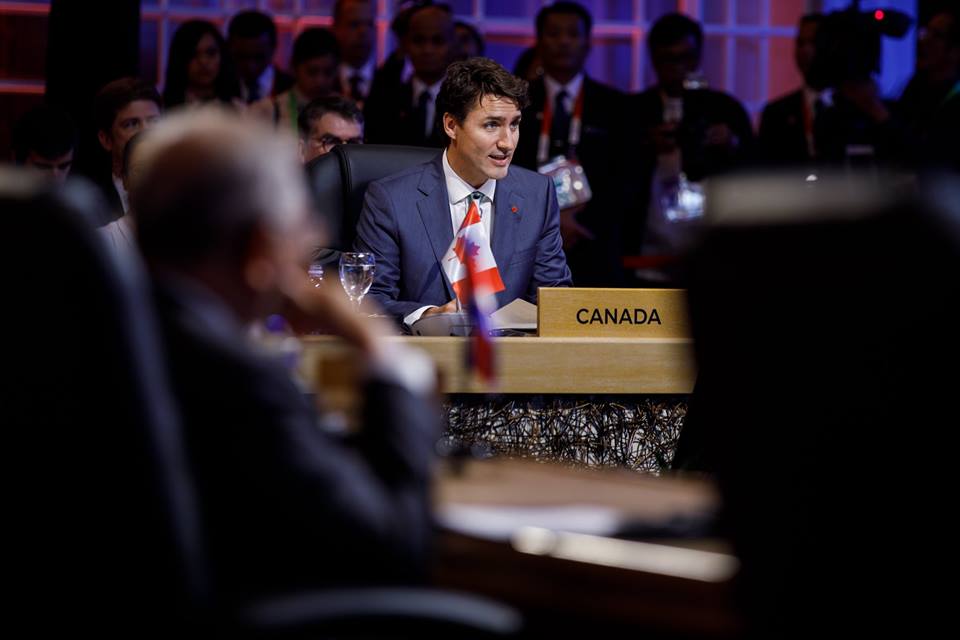
Trudeau unveiled the package of measures and commitments during an address to hundreds of foreign dignitaries and military officials on the second day of a major peacekeeping summit hosted by Canada. (Photo: Justin Trudeau/Facebook)
VANCOUVER— Canada inched closer to a much-anticipated return to peacekeeping on Wednesday as Prime Minister Justin Trudeau offered the UN badly needed soldiers, equipment and a fresh feminist perspective on peace missions.
But while UN officials were effusive in their praise for Canada’s commitments and leadership, two key questions remained: When and where will Canadian peacekeepers be deployed?
Trudeau unveiled the package of measures and commitments during an address to hundreds of foreign dignitaries and military officials on the second day of a major peacekeeping summit hosted by Canada.
The package represented Canada’s most tangible step back into peacekeeping since the Liberals promised last year to provide up to 600 troops and 150 police officers to the UN.
Canada is specifically offering up to six helicopters and two transport aircraft, plus their associated pilots and support personnel, as well as a 200-strong quick reaction force to the UN.
It has also pledged $21 million to help double the number of women deployed on peacekeeping operations around the world, which Trudeau emphasized as critical to bringing peace and stability to conflict-ridden areas.
“Women bring a unique and valuable perspective to conflict resolution,” Trudeau said.
“They look beyond the interests of warring parties, bring the wider community to the table and focus on root causes. Including women and girls in peace operations is a smart, practical pathway to lasting peace.”
Canada is also planning to make dozens of trainers available to the UN and other countries to help professionalize militaries from developing countries that are often involved in peacekeeping.
Some of those trainers will be deployed to UN centres in Africa, such as Kenya, Ghana and Uganda. But officials say up to 50 could also be sent to other countries and may even deploy on missions with their students.
“Six-hundred Canadian armed forces personnel is significant for Canada as a commitment, but let’s remember that there are close to 100,000 peacekeepers deployed around the world,” Trudeau said.
“So we have to focus on how Canada can best help. What we will do is step up and make the contributions we are uniquely able to provide.”
The government’s plan was warmly welcomed by the UN’s top peacekeeping official, Jean-Pierre Lacroix, who asserted that the values that guide peacekeeping are the same espoused by “this great nation of Canada.”
“And with Canada on our side, we feel stronger,” Lacroix said. “We feel more empowered to confront the many challenges that peacekeeping is facing.”
Yet when it came to timelines and specific locations, especially for the deployment of Canadian troops and military equipment, Trudeau remained vague.
That is because Canada has offered them without dictating when and where they must be used, which is what the UN has asked countries to start doing so it has flexibility in filling critical gaps in different missions.
Canada is looking at basing a transport plane in Entebbe, Uganda, that will help ferry UN personnel, equipment and supplies for seven different peacekeeping missions.
“They are exactly consistent with the critical needs that we have in terms of capability, but also the flexibility in which these offers have been made,” Lacroix said of Canada’s pledges.
But government officials told reporters on background that Canada and the UN have only just started what could be six to nine months of discussions about when and where any of those capabilities will be deployed.
Defence Minister Harjit Sajjan said the discussions aren’t just about the UN finding the right fit for Canada’s troops and equipment, but also making sure they have the right support and rules of engagement.
“They’ll do that proper assessment,” Sajjan said of Canadian military officials during a news conference marking the end of the summit.
“I can’t put a timeline to that, but one thing is sure: we’re going to move as rapidly as possible to make sure when we provide those resources, it’s going to have the impact the (UN) needs.”
The lack of detail nonetheless sparked criticism from some observers and foreign dignitaries, who questioned why Canada was only now starting discussions with the UN about where to send military equipment.
They noted, for example, that the UN has told member states for years that it needs helicopters, while the number of Canadian peacekeepers in the field reached a new low last month.
Canada had 62 military personnel and police officers deployed on different missions in October, which was down from 68 in September and 112 in August 2016.
“The Vancouver conference provided an excellent opportunity for Canada to live up to (its) promise,” Royal Military College professor Walter Dorn, one of Canada’s top experts on peacekeeping, said in a statement.
“But Canada has not done so. The delaying and dithering continues.”
Trudeau refused to confirm during a news conference shortly after his address whether the government was still interested in sending helicopters or troops to Mali, as has been widely expected since last year.
The prime minister also sidestepped questions about what level of risk the government is willing to accept when it comes to deciding on a mission, saying that would be only one factor taken into consideration.
“We will always look at the impact that we can have along with the risk profile,” he said.
“What Canadians expect is that we will engage in ways that will make a positive difference around the world, and we will do so in a way that minimizes risks to Canadians. “