Breaking
Deaths at Canada’s Indian residential schools need more study: Commission

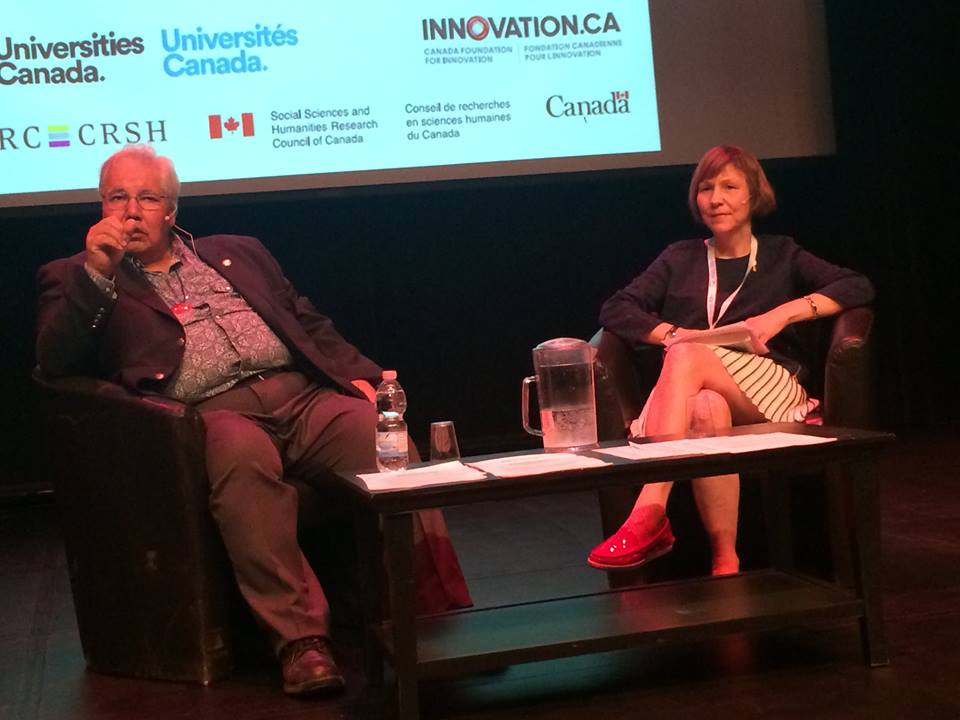
Justice Murray Sinclair and Cindy Blackstock at Canadian Federation for the Humanities and Social Sciences (Truth and Reconciliation Commission of Canada / Facebook)
The commission that has spent five years examining one of the darkest chapters in Canada’s history is winding up its work with a key question left unanswered — exactly how many aboriginal children died in residential schools?
Justice Murray Sinclair, who heads the Truth and Reconciliation Commission, says the federal government stopped recording the deaths around 1920 after the chief medical officer at Indian Affairs suggested children were dying at an alarming rate.
“He was fired,” Sinclair says. “The government stopped recording deaths of children in residential schools, we think, probably because the rates were so high.”
Sinclair has guessed up to 6,000 children may have died at the schools but it’s impossible to say with certainty.
“We think this is a situation that needs further study,” he said.
More than 130 years after the first residential schools were established to “take the Indian out of the child,” the commission is to release a summary of its six-volume final report on Tuesday. It will include testimony from survivors, as well as numerous recommendations to address the legacy of forced assimilation.
The commission didn’t originally intend to examine how many children never came home, but it quickly emerged as an issue, Sinclair says.
Schools were often crowded, poorly ventilated and unsanitary. Children died from smallpox, measles, influenza and tuberculosis.
Some were buried in unmarked graves in school cemeteries, while others were listed as “missing” or “discharged.” In some cases, parents never found out what happened.
Some provinces handed over death certificates to the commission, but Sinclair says the work is far from over.
“We have recommendations around that in the report. We’re going to tell you there are lots of records out there that are missing.”
About 150,000 First Nations, Inuit and Metis children were taken from their families and forced to attend government schools over much of the last century.
The $60-million commission was part of a landmark compensation deal between Ottawa, the Crown and residential school survivors. It visited hundreds of communities and heard testimony from 7,000 survivors, including graphic details of rampant sexual and physical abuse.
The legacy of the schools is evident today, Sinclair says. High poverty rates, a large number of aboriginal children in foster care, a disproportionate number of aboriginals in jail and hundreds of missing and murdered aboriginal women can all be traced back to residential schools, he suggests.
National Chief Perry Bellegarde of the Assembly of First Nations says part of reconciliation is ensuring that aboriginal children have the same quality of life as everyone else. If that doesn’t happen, he says, Prime Minister Stephen Harper’s historic 2008 apology to residential school survivors will mean nothing.
“If we’re going to talk about reconciliation, there really has to be action attached to the apology.”
The churches that ran the majority of the schools have promised to work toward reconciliation.
In a letter from the Ottawa archdiocese, released by the Canadian Conference of Catholic Bishops, Archbishop Terrence Prendergast calls on the faithful to repent for how the church treated aboriginal people.
“We face the past and sincerely ask for forgiveness,” the letter reads.
The Anglican Church of Canada apologized to students and their families in 1993.
“We’ve been trying to live into that apology ever since,” the church says on a website dedicated to reconciliation.
Some worry the commission is ending its work before real healing has begun.
Manitoba Aboriginal Affairs Minister Eric Robinson was sent to a residential school when he was five and left when he was nine – one of the lucky ones, he says.
The number of children who died at residential schools is just one of the areas that needs more exploration, he says. The medical experiments conducted on children, as well as forced military training, should also be properly studied.
“Five or six years is hardly enough time to ascertain a century and more of hurt and punishment inflicted upon Indian people. We almost need a permanent forum.”
Sinclair says the responsibility to repair the relationship with aboriginal people rests with Canadians.
“It’s the people talking at the community level, the need to overcome racism that people have been raised with, overcoming the stereotypes. One of their first obligations is to recognize they are in a relationship with aboriginal people that is like no other.”